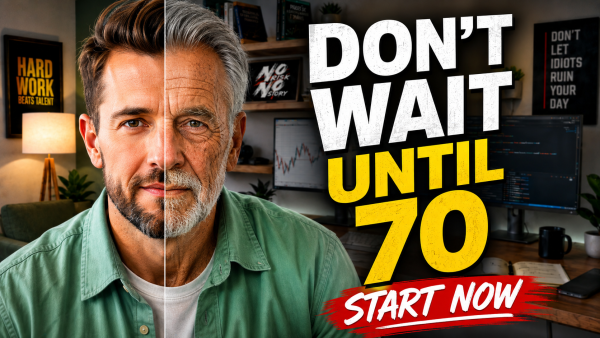
Most people would probably like to have more money, more freedom, and less stress about bills. They would like to wake up on Monday morning and go to work because they choose to, not because they have no alternative. There is nothing wrong with wanting any of that.
The uncomfortable question is what you are actually doing about it. Wanting wealth without wanting the process is a little like wanting six-pack abs without exercising, watching what you eat, or being consistent for months and years. Everybody likes the result; far fewer people like the process that might eventually produce it.
Wanting a result is not the same as building toward it. A financial goal only becomes real when it starts receiving time, attention, discipline, and repeated action.
Wanting Something by Itself Changes Nothing
Saying “I want more money” is not very different from saying “I want to get in better shape.” The statement itself changes nothing. The meaningful question is what happens next: do you put on your gym shoes tomorrow, or do you watch another ten videos explaining why you should exercise?
Finance creates the same illusion very easily. You watch several investing videos, read something about Forex, follow someone talking about entrepreneurship, and save useful content to a “Watch Later” list. All of that can feel like progress, but interest and action are not the same thing, and it is entirely possible that nothing in your financial life has actually changed.
Motivation Helps You Start - Consistency Keeps You Moving
Motivation is useful because it can create the first step. A book, video, conversation, or new idea can suddenly make you think, “Okay, I’m going to do this.” The problem is that motivation is temporary: a few days later, work was terrible, you are tired, the weather is bad, and studying is the last thing you feel like doing.
That is where the difference begins to appear between someone who simply wants a result and someone who is actually moving toward it. Long-term progress does not depend on feeling inspired every day. Just like training in the gym, results usually come from the hundred ordinary sessions you completed even when none of them felt especially exciting.
Financial Progress Has Repetitions Too
At the gym, progress comes from repetitions. Financial development has repetitions as well, but they look different: an hour of studying, practicing a new skill, reducing one unnecessary expense, understanding an investment more deeply, testing a business idea, reviewing a bad trade, reading ten pages of a useful book, writing software, creating something, or applying for a better job.
One of those actions by itself will probably not transform your life. A hundred, five hundred, or one thousand of them may begin to create something very different. The power is not in one dramatic action, but in accumulating useful actions over time.
People Overestimate One Month and Underestimate Five Years
Someone starts investing and three months later asks why the result is so small. Someone starts building a business and six months later wonders why they are not wealthy yet. Someone begins learning to trade and expects meaningful profit after two weeks, while someone else goes to the gym for ten days and decides the program does not work.
In many cases, the problem is not that nothing is happening. The problem is that meaningful progress often takes longer than people want. We are surrounded by fast food, short videos, quick answers, instant entertainment, and stories about rapid success, but many valuable things have one frustrating characteristic: they are slow.
Desperation for Fast Wealth Can Make You Someone Else’s Business Model
The more desperately someone wants immediate results, the easier it becomes to sell them a shortcut. “Double your money in a month.” “Secret strategy.” “Guaranteed returns.” “Only ten minutes a day.” “Automatic money-printing machine.” These promises are effective because they offer exactly what many people want: the result without the process.
The realistic version is much less exciting. Learn, work, save, invest, improve your skills, increase your income, manage risk, and give the process time. It may not make a spectacular advertisement, but it has much more to do with how long-term financial progress usually works.
The more urgently you need a shortcut, the easier it becomes for someone to sell you one.
You Do Not Have to Become Obsessed
None of this means working eighteen hours a day, abandoning your friends, never taking a vacation, or turning life into a productivity competition. That is simply another extreme. You still need rest, entertainment, relationships, and time that serves no financial purpose at all.
But if you genuinely want to be in a stronger financial position five years from now, that intention should appear somewhere in your life today. It might be thirty minutes a day, one hour, or five hours a week. The exact number matters less than giving the goal something real instead of keeping it permanently inside your head.
The Difference Between “I Want” and “I’m Building”
“I want a business” is different from saying, “Every Tuesday and Thursday I spend two hours working on my business.” “I want to invest” is different from setting aside a defined amount every month. “I want to learn trading” is different from spending several hours each week testing, studying, and journaling.
The same applies to careers. Wanting a better job is a desire; creating a six-month plan to learn a marketable skill is a system. A system still cannot guarantee results, but unlike a wish, it creates a process that at least has a chance to produce them.
One Huge Effort Is Not the Same as Consistency
Imagine going to the gym on January 1 and training for five hours. Chest, back, legs, arms, abs, cardio - everything at once. The next day you can barely move, and then you do nothing for the next two months.
Compare that with someone who trains three times a week without doing anything dramatic. They do not post about every workout; they simply continue for months. Financial development works much the same way: a twelve-hour weekend of investing videos is usually less useful than a lifestyle in which learning, saving, testing, and improving happen regularly.
Sometimes the Best Investment Is Not a Stock
For someone with a very low income, the first question may not be which stock to buy. A more powerful question may be how to earn more. Saving $50 a month still has value, but developing a skill that eventually increases monthly income by $300, $500, or $1,000 can have a much larger effect on long-term financial progress.
That is why the best investment is sometimes not a stock, Forex position, or cryptocurrency. It may be your knowledge, skills, experience, professional network, or ability to increase the economic value of one hour of your time.
Wealth Is Not Only About How Much You Earn
Income matters, but income alone does not create wealth. Someone can make a great deal of money and still keep almost none of it if every raise immediately leads to a more expensive car, a larger home, a newer phone, more subscriptions, and more expensive habits.
A simple framework for financial progress is income, retention, and growth. Earn money, avoid spending all of it, and try to put part of what remains to productive long-term use. The theory sounds easy; the challenge is practicing it consistently when everyday consumption constantly offers something more enjoyable to do with the money.
Sometimes Financial Discipline Means Saying No
Discipline is rarely exciting. Maybe you can afford a new phone, but the old one still works. Maybe financing a more expensive car is possible, but you choose not to. Maybe you could spend two hours scrolling tonight, but instead you study, or you could spend your entire paycheck but decide to keep part of it.
That does not have to mean punishing yourself or refusing everything enjoyable. It simply recognizes that your present self and future self do not always want the same thing. Financial discipline often means allowing the future version of you to win some of those arguments.
You Are Going to Make Mistakes
Nobody makes every financial decision correctly. Some investments will perform worse than expected, business ideas will fail, a skill may turn out not to suit you, and traders will have losing positions. That is normal, just as every day in the gym is not a personal record.
The important question is not whether you can avoid every mistake. It is whether one mistake can remove you from the game permanently. Progress requires room for error, because without that room there is no opportunity to learn, adapt, and continue.
That Is Why Risk Management Matters So Much
This becomes especially important in financial markets. You can have excellent analysis, a strong strategy, and even a 70% win rate, but if one badly sized position can destroy the account, the larger problem is not the entry.
The objective is not only to make money; it is also to stay in the game. As long as you still have capital, time, and the ability to learn, you still have opportunities to improve. A decision that puts everything at risk can remove all three at once.
Progress requires mistakes. Risk management is what helps prevent one mistake from ending the entire process.
“I’m Just Not Talented at This” Is Often Used Too Early
If you have never studied programming, it is normal that you cannot code yet. If you have never studied finance, financial terminology will probably feel unfamiliar. If you have never built a business, there is no reason to expect yourself to understand every part of it on day one.
Nobody reasonably walks into a gym for the first time, fails to lift an extremely heavy barbell, and concludes that fitness is not for them. They start lighter and improve. Financial knowledge, professional skills, and business experience can develop in much the same way.
There Is Nothing Wrong With Being a Beginner
Everyone was a beginner at something. There is no shame in not knowing what an ETF is, how leverage works, what inflation means, how compound interest works, what Margin is, or how to read an earnings report. Ask, read, and learn.
Not understanding something today is not the real danger. The greater problem is still not understanding it five years from now simply because the learning process never began. Ignorance can be temporary, but only if something is done about it.
Do Not Compare Your Beginning With Someone Else’s Twenty-Year Career
Comparison can destroy motivation very quickly. You start learning and immediately compare yourself with someone who has been an entrepreneur for twenty years, trading for ten, or programming for fifteen. Naturally, you are behind them because they started years before you did.
A more useful comparison is with your previous self. Do you understand more than last year? Earn more? Manage money more carefully? Make fewer avoidable mistakes? If the answer is yes, progress is happening even if somebody else remains far ahead.
Wealth Does Not Need One Universal Number
Financial progress should not be reduced to an arbitrary target such as needing ten million dollars to be considered successful. One person may want to own a home, another wants to eliminate debt, someone else wants an additional $1,000 per month in relatively passive income, retire earlier, build a company, or simply save enough that an unexpected bill no longer creates panic.
The objective does not have to be becoming the richest person in the room. A much more practical definition of progress may be reaching a point where money controls fewer of your choices and creates less fear around ordinary life decisions.
You Cannot Completely Outsource Your Financial Development
Financial progress requires something in return: time, energy, attention, discipline, discomfort, sometimes money, sometimes mistakes, and often years. Just as you cannot pay someone else to do your sit-ups and somehow receive the physical result yourself, you cannot completely outsource your financial understanding.
You can use an advisor, accountant, investment fund, or automated system, and all of those can be useful. But you should still understand at least the basics of what is happening with your own money because you ultimately live with the consequences of those decisions.
Where SignalCrumbs Fits Into This
SignalCrumbs is not a “press this button and get rich” solution. We share the activity of our own automated trading system and create educational material around Forex, Margin, leverage, risk, trading strategies, and the logic behind approaching markets systematically.
Even then, the learning still belongs to you. You need to ask questions, conduct your own research, identify what you understand, recognize what you do not understand, and decide what you want to learn next. The long-term objective should not be having somebody else tell you what to do forever, but gradually becoming capable of understanding why decisions are being made.
Do Not Wait Until You Suddenly Feel Motivated
You probably will not wake up every morning excited to study financial statements, just as you probably do not spend every evening looking forward to doing a hundred sit-ups. But you can still do the work because you understand why it matters.
Motivation says, “I feel like doing this.” Purpose says, “I have a reason to do this.” The second can be much more durable because it survives days when enthusiasm disappears.
What Do You Want Your Life to Look Like in Ten Years?
Think beyond tomorrow and next week. Where would you like to live? How much would you like to work? What would you like to spend your time doing? How much financial security would you like to have? Do you want to travel more, own a business, buy a home, retire earlier, or spend more time with your family?
You do not need an exact financial number. A rough picture is enough to ask the more useful question: are your current habits moving you toward that version of your life? If they are not, you do not need to redesign everything immediately; changing one repeatable behavior can already be a meaningful start.
Start With One Thing You Can Repeat
One hour of learning. One book. One budget. One savings goal. One new skill. One project. One experiment. One investment plan. One workout. Then repeat it.
Many people never start because they imagine that progress requires a dramatic transformation. Often, the better first step is one useful action small enough to perform again tomorrow, next week, and next month.
You do not need one enormous transformation. You need a useful action small enough to repeat until it becomes part of your life.
Final Thoughts
Of course it would be nice to have more money, more freedom, more options, and less financial stress. Almost everybody wants the result. The more important question is what you are willing to do consistently to move toward it - not once, and not only while motivation is high, but week after week, month after month, and year after year.
Your path may involve building a business, investing, learning a higher-paying profession, trading, or combining several approaches. There is no single route, and none of them guarantees wealth. But if nothing changes in your behavior, skills, income, saving, or decision-making, expecting a dramatically different result becomes difficult.
Start somewhere today. Read ten pages, study for thirty minutes, set aside some money, write down a plan, test an idea, or begin that project you keep postponing. One sit-up will not create six-pack abs, and one good financial decision will not make anybody wealthy, but every long-term process eventually begins with its first repetition.
If financial markets and Forex are among the areas you want to understand better, you can find educational material and a closer look at how our own automated trading system works at SignalCrumbs.com .
 Related posts