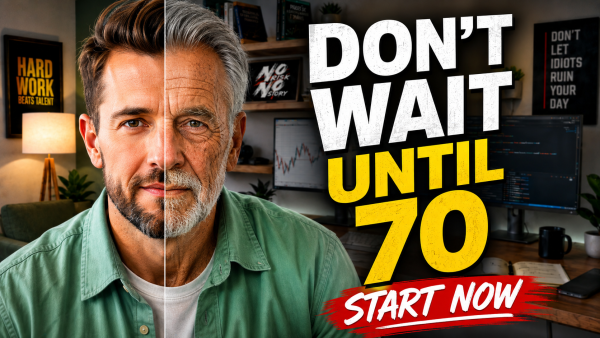
There is a sentence that may sound harsh at first: your boss is not your friend, your father, or someone who pays you because they love you. You are paid because your work creates value for the business - ideally more value than the company spends employing you.
There is nothing inherently wrong with that. The owner takes risks, invests capital, finds customers, hires people, and expects the business to generate a profit. You provide your time, knowledge, and energy, and in return you receive income.
The real problem begins when twenty or thirty years pass and you suddenly realize that while you spent every day helping someone else build their goals, you kept postponing your own. The company may have grown, gained customers, increased revenue, and made its owners wealthier, while something else happened quietly in the background: you got older.
Time is the one resource no future salary increase can ever give back to you.
Your Workplace Is Not Your Family
Many companies like to say that everyone is part of one big family. Sometimes that culture can genuinely feel positive: you may like your coworkers, respect your manager, and enjoy the place where you work.
But a family and an employment relationship are not the same thing. If the company enters serious financial trouble, your position may disappear regardless of how loyal you have been. There may be layoffs, restructuring, new ownership, or strategic decisions that make financial sense for the business while being painful for you personally.
That does not automatically make the company evil. It means the company is behaving like a business, and employees should also be able to think about their own future professionally.
If a better opportunity appears for your life, family, finances, or long-term goals, leaving does not necessarily mean betraying anyone. Loyalty can be valuable; permanent self-sacrifice is something different.
You Are Selling More Than Eight Hours
A full-time job rarely consumes only the eight hours written into the employment contract. You wake up, prepare, commute, work, commute home, and often arrive with considerably less energy than you had at the beginning of the day.
An eight-hour job may therefore control ten or eleven hours of your day. And it does not consume only time: it uses attention, creativity, mental energy, problem-solving capacity, and often the hours when you are most productive.
That is why evaluating a job only by annual salary can be misleading. The more useful question is also: what am I building for myself while I am doing this?
Maybe you are gaining valuable knowledge, professional connections, capital, experience, retirement savings, or skills that could later support your own project. That is very different from repeatedly selling the same hours every month while hoping that life will somehow become different by itself.
“Someday” Can Become a Dangerous Habit
“Someday” is one of the easiest words to use because it removes the need to make a decision today. Someday when the salary is higher, the mortgage is lower, the economy improves, the student loan is gone, retirement arrives, or enough money has somehow accumulated.
The responsibility is quietly transferred to a future version of yourself. That future person will supposedly have more courage, more time, more money, and fewer problems.
But there is no guarantee that this will be true. Twenty years from now you may have more responsibilities, less energy, different health circumstances, or completely different family obligations.
A more useful question is: what part of the life you want someday can you begin building now?
You Do Not Need to Become a Millionaire Before You Begin
People often connect their goals to a future level of wealth. They imagine traveling once they become rich, starting a business once they have hundreds of thousands of dollars, exercising once they no longer need to work, or finally pursuing their ideas once financial pressure disappears.
But the first version of a goal usually costs far less than the complete dream. Maybe you cannot afford a three-week first-class trip, but you can take a long weekend. You may not have enough capital for a full-scale business, but you can spend an hour tonight researching the idea.
Maybe you cannot leave your job yet, but you can begin learning a skill that creates more options two years from now. Maybe buying a home is still far away, but saving the first part of the down payment can begin today.
The important question is not whether you can complete the entire dream immediately. It is whether you can take the first small step.
The Lottery Is a Very Comfortable Fantasy
Winning tens of millions in the lottery is attractive partly because it appears to solve everything without requiring us to create the change ourselves. Suddenly the house can be bought, the job can be left, the business can be started, and the travel can begin.
But there is something useful hidden inside that fantasy. If you already know exactly how you would spend your time after winning $50 million, then you probably already know quite a lot about the life you actually want.
The next question is whether every part of that life really requires $50 million. A Ferrari might, but more free time, a side business, a new skill, a small investment portfolio, or more frequent travel may not.
You may not be able to purchase the entire dream today, but parts of it may already be buildable.
This Is Not an Argument for Quitting Tomorrow
It is easy to move too far in the opposite direction. Motivational content often makes quitting a job sound like a heroic solution to every problem, but real life includes rent, mortgages, insurance, car payments, student loans, groceries, children, and family responsibilities.
Irresponsibility is not freedom. A better approach is usually to build a plan.
Your current job may actually finance your path toward greater independence. Salary can help create a three-to-six-month emergency reserve, pay for education, finance equipment, build an investment portfolio, or provide the runway needed to test a side business without immediately putting your financial stability at risk.
You do not need to burn everything behind you. But you do need to start building something in front of you.
The Comfortable Prison
One of the most dangerous jobs is not necessarily a terrible one. Sometimes it is the job that is just comfortable enough to keep you from changing anything.
The salary is acceptable, health insurance is provided, perhaps there is a retirement-plan match, coworkers are fine, and the work is not unbearable. You are not especially happy, but you are also not unhappy enough to force a decision.
That is exactly why the situation can last for years. “One more year” becomes “now is not a good time,” which becomes “I will definitely start next year.”
Then five years have passed, followed by ten. Nothing dramatic happened, and that is precisely what made the change difficult to notice.
Your Employer’s Goals Are Already on Your Calendar
Your employer generally knows how a large part of your week will be used. Meetings, deadlines, presentations, reports, monthly targets, quarterly targets, KPIs, and annual objectives are all scheduled in advance.
Now compare that with your personal goals. Where are they on the calendar? Many of them remain in vague categories such as “when I have time,” “maybe this weekend,” or “I will start in January.”
It is an interesting contradiction. People reliably show up at the correct time for someone else’s objectives while their own goals may remain unscheduled for years.
You may not need five additional free hours every day. You may need to start scheduling your own goals with the same seriousness as the goals you complete for your employer.
Five Hours a Week Can Become 1,300 Hours
Five hours a week may feel insignificant. It is less than one hour per day, and the individual sessions may not appear to change much.
But over one year, five hours a week adds up to roughly 260 hours. Over five years, that becomes approximately 1,300 hours of focused effort.
That is enough time to make serious progress in a programming language, a new profession, a YouTube channel, a website, a product, a business idea, or the foundations of a trading system.
The problem is often not that absolutely no time exists. It is that small amounts of available time are dismissed as too insignificant to matter, even though those hours are often what later accumulate into the result outsiders call an overnight success.
Your Job Can Be a Tool
There is no need to hate employment. A job can provide stability, capital, professional experience, useful contacts, technical knowledge, and skills that become much more valuable later.
Use those advantages. Build savings, contribute to retirement accounts, learn from the work, and develop skills that improve your options.
The key is making sure you are also moving in your own direction. Not every useful stop on the journey needs to become the final destination.
If you genuinely love your work and want to continue doing the same thing twenty years from now, there is nothing wrong with that. But if every Sunday includes the thought that you want a different life someday, then Monday should probably include at least one small action toward that alternative too.
Start Ridiculously Small
Large goals often prevent people from starting because they are mentally processed as one enormous task. Starting a company, buying a home, building investment income, changing careers, or developing a product can all look overwhelming when viewed as complete projects.
So do not complete the entire project today. Do the first 0.1%.
- Write down the idea.
- Register the domain.
- Research the cost.
- Study for thirty minutes.
- Save the first $100.
- Write the first hundred lines of code.
- Build the first crude prototype.
- Contact one potential customer.
None of those actions will transform your life overnight. But something important changes immediately: the project is no longer only something you talk about.
You started.
Do Not Save Your Entire Life for Retirement
The traditional path is familiar: study while young, work for several decades, pay the mortgage, build retirement savings, and finally gain time around the age of 65 or 67 to travel, relax, and pursue hobbies.
Planning for retirement is important, and long-term saving should not be ignored. But that does not mean every enjoyable part of life automatically needs to be delayed until the final stage of a career.
Why should the first long trip wait until retirement? Why should a hobby that has been interesting for twenty years remain postponed? Why should every meaningful goal be moved into a future period whose health, finances, and family circumstances are impossible to know today?
Save, invest, and build security - but live as well. Your current life is not a waiting room.
The Same Day Will Arrive One Year From Now Anyway
One of the weakest arguments against pursuing a goal is that it will take too long. Imagine wanting to learn something that requires a year of consistent effort.
One year from now, that date will arrive regardless. There are simply two different versions of it: in one, you are still saying that you want to begin someday; in the other, you have already spent a year learning.
Time passes whether progress happens or not. That is exactly why the length of the journey is often a poor reason not to begin.
Nobody Is Going to Work on Your Goals for You
Your boss has objectives. The owner of the business has objectives. Your coworkers have plans for their own lives as well.
What are you building?
It is unlikely that someone at work will suddenly decide that you have spent enough time contributing to the company and should now go home early every Friday to develop your own ideas. Not because they are bad people, but because your personal goals are not their responsibility.
They are yours. That may sound demanding, but it is also empowering because it means you do not need anyone’s permission to begin.
Employment Should Be a Fair Exchange, Not Your Entire Identity
In a healthy employment relationship, both sides receive something valuable. You receive income, stability, experience, and perhaps professional development. The business receives your work, knowledge, and productive time.
Nothing about that arrangement is inherently unfair. The mistake is assuming that because the relationship is useful today, it must automatically remain the best possible structure for the rest of your life.
Your career can be part of your plan without becoming the whole plan.
How This Relates to Our Own SignalCrumbs Journey
Our automated trading system was also built through small steps rather than one dramatic decision. It involved years of development, tests that failed, mistakes, redesigns, new rules, technical fixes, and countless incremental improvements.
The early versions did not look like the system we have today. Progress came from continuing to work on the project alongside everything else rather than waiting for a perfect moment when unlimited time and resources would somehow become available.
If you would like to see how far that development has progressed, you can follow the system’s positions from opening to final closure at SignalCrumbs.com .
Final Thoughts
Your boss does not need to be your friend or your father. In a fair employment relationship, the business receives valuable work and you receive valuable compensation, experience, and stability.
But your own life is progressing at the same time. Every month spent working toward someone else’s objectives is also a month that has passed in your own life, which makes it worth asking what you are building alongside your employment.
You do not need to quit tomorrow, invest $100,000, or completely redesign your life this week. The first action might be thirty minutes of study, one chapter of a book, one email, the first $100 saved, one customer contacted, or the first hundred lines of code.
The size of the first step matters much less than the fact that it finally exists.
Your employer already has a plan for how to use your time tomorrow. The important question is whether you also have a plan for how to build your own future.
Stop waiting for your life to begin someday. It already has.
 Related posts