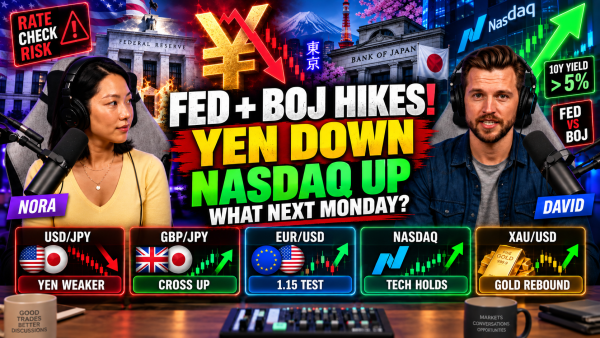
Friday delivered a dramatic ending to the Forex trading week, particularly for currency pairs involving the Japanese yen. USD/JPY dropped sharply, GBP/JPY experienced an even more aggressive decline, and the yen strengthened rapidly across several major currency crosses.
Whenever the market produces a sudden movement like this, traders immediately begin searching for an explanation. Was it Japanese currency intervention? A central-bank announcement? An unexpected political statement? Or did something fundamental change in the outlook for interest rates?
Those questions are reasonable, but significant market movements rarely have only one cause.
Friday's yen rally may be better understood as the interaction between several forces: intervention fears, changing market expectations, crowded Short JPY positioning, and stop-loss orders that may have accelerated the decline once important technical levels began breaking.
That last element deserves particular attention because it helps explain why a move that begins relatively normally can suddenly become extremely aggressive.
When many traders hold similar positions, the market can experience a chain reaction as those positions are closed. Selling creates additional selling, important levels break, and the price can travel much further than participants initially expected.
The result is especially dangerous for leveraged traders, carry-trade strategies, and portfolios holding multiple positions exposed to the same currency.
So what actually happened during Friday's yen rally? How can stop-loss orders contribute to a rapid market decline? And what are the three main scenarios for USD/JPY and GBP/JPY when trading resumes on Monday?
More importantly, how can you manage the risk of a violent market movement without pretending that you know exactly what will happen next?
Why Did USD/JPY and GBP/JPY Fall So Sharply on Friday?
The Japanese yen strengthened rapidly toward the end of Friday's session, creating substantial downward pressure on USD/JPY and GBP/JPY.
The immediate market narrative focused heavily on the possibility of Japanese currency intervention. Japan has previously intervened to support the yen when authorities considered its depreciation excessive or disorderly, so a sudden rally in the currency naturally raised questions about official involvement.
However, intervention was not the only possible explanation.
Investors were also reassessing the broader monetary-policy environment, while many existing positions may have been vulnerable after an extended period of yen weakness.
When a currency pair has moved in one direction for a long time, traders can become increasingly comfortable holding positions that benefit from the established trend.
In the case of yen crosses, interest-rate differentials have encouraged many market participants to hold positions that benefit from a relatively weak yen.
That can create a crowded market.
If an unexpected development suddenly strengthens the yen, some traders may voluntarily reduce exposure. Others may have predefined Stop Loss orders activated as price crosses important levels.
If enough orders are concentrated in the same areas, the resulting transactions can reinforce the original movement.
A market decline can begin because traders change their expectations, but it may accelerate because existing positions are being closed.
Friday's key lesson: Sudden currency movements can result from several interacting forces. Intervention speculation, changing expectations, crowded positioning, and stop-loss liquidation can reinforce one another, creating moves that are much larger and faster than the initial catalyst alone might suggest.
How Stop-Loss Cascades Can Accelerate a Forex Market Crash
A Stop Loss is designed to close a position when the market reaches a specified level. It is an important risk-management tool, but when many traders place similar orders around the same prices, their collective execution can influence short-term market behavior.
Imagine a large number of traders holding Long USD/JPY positions.
Some entered around 154.00, others around 155.00, and another group around 156.00. Many have placed protective Stop Loss orders below nearby support levels.
For a Long position, a conventional sell-stop order becomes eligible for execution when its trigger conditions are met. Depending on the order type and execution arrangements, the position may then be closed through market execution at the available price.
When USD/JPY falls through a level where many stops are concentrated, additional selling can enter the market.
The Chain Reaction Behind a Stop-Loss Cascade
- An important support level breaks. Selling pressure pushes the currency pair below a price that many traders considered technically significant.
- The first group of Stop Loss orders is triggered. Traders holding Long positions begin exiting automatically.
- Those exits create additional selling pressure. Available liquidity may be insufficient to absorb every order at the same price.
- The next support level breaks. Additional traders and automated strategies react to the decline.
- More positions are closed. Stop orders, discretionary exits, and margin-related liquidation can reinforce the movement.
- The decline accelerates. The currency pair may move rapidly until sufficient buying interest and liquidity emerge.
This is sometimes described as a stop-loss cascade or liquidation cascade.
The process does not require every market participant to suddenly become bearish. Some selling occurs because traders who previously expected higher prices are now closing positions.
That distinction helps explain why a market move can become unusually fast even without a continuous stream of new negative headlines.
Why Liquidity Matters During Stop-Loss Cascades
In Forex, available liquidity and quoted spreads can change rapidly during periods of stress.
When aggressive sell orders arrive faster than available buyers are willing to absorb them at existing prices, quotes may move sharply lower.
A Stop Loss trigger does not necessarily guarantee execution at the exact requested level. Slippage can occur, particularly during sudden price movements or gaps in available liquidity.
For leveraged positions, the difference between the intended exit and the actual execution price can become financially significant.
This is why a Stop Loss is an important part of risk management, but it is not a guarantee that a trade's realized loss can never exceed the original plan.
Stop-loss cascades illustrate how market positioning, execution mechanics, and changing liquidity can turn an ordinary price decline into a violent movement.
Why GBP/JPY Can Be More Volatile Than USD/JPY
GBP/JPY reacted even more aggressively than USD/JPY during Friday's yen rally.
This is not particularly surprising. GBP/JPY often experiences larger price movements than several other major Forex pairs because it combines the British pound and the Japanese yen, both of which can respond strongly to changes in monetary-policy expectations and global risk sentiment.
When the yen appreciates sharply, GBP/JPY can fall hundreds of pips in a relatively short period, especially if sterling is not strengthening enough to offset the move.
Currency Pair Volatility Changes the Meaning of Position Size
Consider two positions with the same lot size: one in EUR/USD and one in GBP/JPY.
They do not necessarily carry the same financial risk.
Their pip values may differ depending on contract specifications and account currency, while their typical volatility, Stop Loss distances, and market behavior can be substantially different.
A lot size that is appropriate for a relatively stable EUR/USD setup may create excessive risk when applied mechanically to a more volatile GBP/JPY position.
That is why lot-size consistency should not be confused with using an identical number of lots across every instrument.
Consistency means that position sizing follows the same risk framework while accounting for the specific characteristics of each currency pair.
Two Sources of Currency Risk in GBP/JPY
GBP/JPY is influenced by developments affecting both sterling and the yen.
If the yen strengthens because investors reduce carry-trade exposure, GBP/JPY may decline even when there is no major change in the British economic outlook.
If sterling weakens at the same time, the downward movement can become more pronounced.
Conversely, if yen strength suddenly fades while sterling remains relatively firm, GBP/JPY can experience a substantial upward correction.
Those competing influences make short-term prediction difficult and emphasize the importance of risk controls that account for sudden changes in volatility.
Was Friday's Yen Rally Caused by Japanese Currency Intervention?
Currency intervention quickly became one of the leading explanations discussed after Friday's movement.
Japanese authorities have a history of intervening in the foreign-exchange market when yen depreciation becomes excessive or disorderly.
Consequently, traders tend to become particularly sensitive to intervention-related headlines when USD/JPY approaches politically important exchange-rate regions.
However, there is an essential difference between suspected intervention and confirmed intervention.
The price movement itself does not establish that an official operation occurred.
In the absence of reliable confirmation, Friday's movement should be described as taking place amid intervention speculation and related market uncertainty, not as proof of a new official intervention.
Intervention Expectations Can Move Markets Without Confirmation
Even when no intervention has been confirmed, the possibility alone can influence trading behavior.
Imagine holding a profitable Long USD/JPY position after an extended upward trend. Suddenly, the yen strengthens sharply, and market participants begin discussing whether Japanese authorities have entered the market.
You may decide to reduce exposure rather than risk another unexpected intervention shock.
Other traders may take similar action, while automated systems respond to technical levels or increased volatility.
Those decisions can generate additional yen demand and contribute to the currency's appreciation.
In other words, traders do not always wait for official confirmation before adjusting their positions.
Financial markets respond to expectations, uncertainty, and changes in perceived risk.
Official Intervention May Become Clear Only Later
Currency intervention does not necessarily come with a warning delivered before the market moves.
Authorities may act first, while details and confirmation become available later through official statements or intervention reporting.
That uncertainty matters because it prevents traders from treating the absence of immediate confirmation as proof that intervention risk has disappeared.
Traders should distinguish between what the market suspects, what has been officially confirmed, and what remains an interpretation of price action.
Did Friday's Selloff End the Long-Term Bullish Trend in Yen Crosses?
One dramatic trading session is not enough to establish that the longer-term trend has permanently reversed.
Yen crosses have benefited for extended periods from substantial interest-rate differentials between Japan and several other major economies.
Those differences helped make yen-funded carry trades attractive to investors seeking positive financing characteristics.
When a trader holds a higher-yielding currency against a lower-yielding funding currency, the position may generate positive carry, depending on broker pricing, swaps, and other conditions.
That can create an incentive to maintain exposure over longer periods.
However, the interest-rate differential does not prevent unfavorable exchange-rate movements.
A Violent Correction Is Not Automatically a Structural Reversal
There are several ways Friday's movement could eventually be interpreted.
It might prove to be a relatively short-lived correction within an established trend. It could mark the beginning of a broader adjustment in positioning. Or it might reflect a temporary combination of intervention fears and stop-loss liquidation without a lasting change in monetary-policy fundamentals.
Determining which interpretation is more appropriate requires additional information.
Market behavior during the following sessions, central-bank communication, changes in interest-rate expectations, and the strength of subsequent rallies or declines can all help clarify the picture.
A single large candlestick may be visually dramatic, but it does not provide a complete explanation of the longer-term trend.
One violent Friday session can change short-term market risk immediately without necessarily proving that the long-term economic environment has reversed.
Was Friday's Movement a Yen Carry-Trade Unwind?
At least part of Friday's yen rally may have involved the reduction of existing carry-trade positions.
Carry trading is sometimes presented in relatively comfortable terms: favorable interest-rate differentials, positive swaps, and the ability to collect financing income while holding a position.
But positive carry is not free money.
The potential financing benefit is only one component of the total result. Exchange-rate movements can easily outweigh accumulated swap income.
Why Carry Trades Can Become Crowded
When a particular funding relationship remains attractive for a long period, more investors may begin using similar positions.
That can create concentrated exposure across several currency pairs.
For example, Long USD/JPY, Long GBP/JPY, and Long AUD/JPY all involve exposure to a relatively weak yen.
Although the instruments are different, yen appreciation can produce losses across the portfolio simultaneously.
If investors begin closing those positions together, they generate additional demand for yen.
That can reinforce the original strengthening movement and increase the pressure on remaining Short JPY positions.
Positive Swap Cannot Protect Against a Large Currency Move
Imagine a carry-trade position accumulating favorable financing income over several weeks.
A sudden exchange-rate movement of several hundred pips can create a loss substantially larger than the previously accumulated swap income.
The problem becomes more serious when traders use excessive leverage or maintain too little Free Margin.
Even if the longer-term interest-rate thesis remains plausible, the account may not have sufficient capacity to tolerate a severe drawdown.
This is why carry trading requires a complete approach to position sizing, portfolio exposure, margin management, and market-regime risk.
Carry-trade risk: Positive swap income cannot guarantee protection against sudden currency appreciation. Crowded Short JPY exposure, leverage, and correlated positions can turn a yen rally into a substantial portfolio drawdown or forced liquidation event.
Monday Forex Outlook: Three Possible Scenarios After Friday's Yen Rally
After such an aggressive movement, there is no reliable reason to assume that Monday must continue in exactly the same direction.
A strong decline can be followed by further selling, a substantial technical rebound, or a period of consolidation.
Each possibility has a different interpretation, and none should be treated as guaranteed.
Scenario 1: USD/JPY and GBP/JPY Correct Higher
The first possibility is that the yen gives back part of Friday's gains.
After a sudden strengthening movement, traders holding profitable yen positions may decide to take profits.
At the same time, traders who believe the broader bullish trend in USD/JPY remains intact may interpret lower prices as a potential entry opportunity.
The resulting buying could produce an upward correction in USD/JPY and GBP/JPY.
Such a rebound would not automatically mean Friday's movement was irrelevant.
It could simply represent a technical retracement after unusually aggressive selling.
To evaluate this scenario, it would be useful to observe whether prices recover important broken levels and whether the rebound is accompanied by decreasing volatility or renewed buying momentum.
Scenario 2: The Yen Continues Strengthening
The second scenario is a continuation of Friday's movement.
If USD/JPY and GBP/JPY begin falling again and break below Friday's lows, more traders may conclude that the decline represents something larger than a temporary market shock.
That could generate another wave of position reduction.
Possible contributing factors include additional Stop Loss orders, voluntary liquidation of Long positions, margin-related risk reduction, and further unwinding of carry-trade exposure.
Psychology can also contribute.
Traders who maintained Long positions throughout Friday's decline may decide that another unfavorable movement on Monday is the point at which they can no longer tolerate the risk.
If enough participants reach that conclusion at similar price levels, the resulting selling can reinforce the downward momentum.
A break of Friday's lows could therefore become important not only technically but also because it may trigger another wave of position exits.
Scenario 3: Volatility Declines and the Previous Trend Rebuilds
The third possibility is that the market begins stabilizing.
Friday's large movement may have cleared part of the crowded positioning, while the absence of additional intervention pressure or significant new monetary-policy developments could allow market conditions to normalize.
In that environment, volatility might decline and trading ranges could become narrower.
If the broader interest-rate differential remains supportive of the original trend, some investors may gradually rebuild positions.
However, that process does not need to happen immediately.
The market may require several sessions to determine whether Friday's decline represented a temporary disruption or a more significant shift in positioning.
For this reason, patience and observation may be more useful than trying to label the entire movement after just one session.
Monday Scenarios at a Glance
| Scenario | Possible market behavior | What to monitor |
|---|---|---|
| Upward correction | USD/JPY and GBP/JPY recover part of Friday's decline as yen strength fades. | Profit-taking, recovery of broken levels, rebound momentum. |
| Further yen strength | Friday's lows break and another wave of Long-position liquidation pushes yen crosses lower. | Stop-loss cascades, liquidity, intervention headlines, carry-trade unwinding. |
| Stabilization | Volatility decreases and the broader pre-Friday trend gradually attempts to rebuild. | Price consolidation, reduced volatility, monetary-policy expectations. |
The important distinction is that these are conditional scenarios, not predictions. Market participants should remain willing to change their interpretation when new information becomes available.
Should You Trade Immediately When Forex Markets Open on Monday?
After a particularly violent Friday, the beginning of Monday's session can be difficult to interpret.
Liquidity may be different from normal conditions, some traders may still be adjusting their exposure, and weekend developments could produce an opening gap.
Spreads may temporarily widen, while a burst of volatility can trigger trading signals that later prove unreliable.
That environment can be especially tempting for traders who fear missing another substantial market movement.
Do Not Confuse a Dramatic Chart With a Valid Entry Signal
Imagine seeing Friday's enormous bearish candlestick in USD/JPY.
You conclude that the yen must continue strengthening and decide to open a Short position immediately when trading resumes.
But what if the market begins with a strong upward correction?
Alternatively, you might assume the decline has already gone too far and open a Long position, only for another wave of selling to begin.
Neither conclusion becomes reliable simply because Friday's movement was unusually large.
A valid trading decision should still depend on the strategy's entry conditions, invalidation criteria, exposure limits, and risk calculations.
For some systems, waiting for liquidity and price behavior to stabilize may be entirely appropriate.
Missing the first part of a Monday movement may be less damaging than entering a position solely because you feel compelled to participate.
Could USD/JPY Move Another 100 to 200 Pips?
Given the volatility described in Friday's session, another movement of approximately 100-200 pips would not be inconceivable.
If a major development occurs, such as confirmed intervention, an unexpected monetary-policy statement, or another wave of forced liquidation, even larger movements cannot be excluded.
However, that does not mean traders should confidently expect a particular 200-pip or 400-pip move.
These figures are useful as illustrative stress scenarios, not precise forecasts.
Why Stress Testing Matters More Than Predicting the Exact Move
Imagine holding several Long USD/JPY positions.
Rather than asking only whether Monday's price will rise or fall, consider how the account would behave if the pair declined another 100, 200, or potentially more pips.
How much would Equity decrease? What would happen to Free Margin and Margin Level? Would the portfolio remain within its predefined risk limits?
The calculation becomes even more important when positions are held across multiple yen crosses.
If USD/JPY and GBP/JPY both decline sharply, the combined account loss may be significantly larger than the risk suggested by examining either trade independently.
The purpose of considering a large adverse scenario is not to predict it. It is to understand whether the account could tolerate it.
GBP/JPY May Experience Even Larger Short-Term Movements
GBP/JPY deserves particular caution after a sudden yen rally.
The pair can respond aggressively to changes in yen demand, while sterling-related developments may amplify or partially offset those movements.
If the yen continues strengthening, GBP/JPY could experience another sharp decline.
But if intervention concerns fade and the yen weakens again while sterling remains relatively firm, the rebound could also be substantial.
This creates meaningful uncertainty for short-term traders.
Scalpers using large position sizes may be particularly vulnerable when spreads widen or execution differs from expected conditions.
Longer-term traders and automated systems must consider whether the combined exposure remains appropriate across a much wider range of potential outcomes.
A chart showing a large number of pips may look attractive, but what ultimately matters is how those pips translate into account risk.
That requires understanding contract specifications, pip value, position size, leverage, and current portfolio exposure.
Leverage and Position Sizing: The Real Danger During a Yen Shock
Leverage allows traders to control exposure greater than the capital committed as margin.
This can amplify returns when price moves favorably, but it also amplifies losses relative to account Equity when price moves against the position.
During a sudden yen rally, the same price movement can have dramatically different financial consequences for two traders holding different position sizes.
A conservatively sized position may experience a manageable drawdown, while a highly leveraged position could reach critical margin thresholds.
The Dangerous Belief That Price Has Already Moved Too Far
After a large decline, traders sometimes assume that another significant fall is impossible.
They may think that USD/JPY has already dropped so much that a rebound must be imminent.
But the market does not recognize a trader's personal definition of an excessive movement.
Once important liquidity levels break and market positioning begins changing, a decline can continue well beyond what previously seemed reasonable.
That is why opening a larger position merely because a currency pair has already moved substantially can become dangerous.
It is particularly problematic when a trader combines that assumption with aggressive DCA, excessive leverage, or insufficient margin reserves.
Margin, Free Margin and Portfolio Exposure Matter More Than One Trade
During volatile market conditions, the risk of the complete trading account becomes more important than the apparent attractiveness of any one position.
A trader might hold several individually small positions that share substantial Short JPY exposure.
When the yen strengthens, those trades can experience losses at approximately the same time.
Equity falls, available Free Margin declines, and the account's Margin Level may deteriorate.
If the account reaches the broker's margin close-out threshold, positions may be reduced or liquidated according to the applicable rules.
That can happen even if the trader believes the original market thesis will eventually prove correct.
Why More Free Margin Provides Flexibility but Not Certainty
Maintaining an appropriate margin buffer can give the account additional capacity to tolerate adverse movements without immediately reaching forced-liquidation thresholds.
However, having more room does not guarantee that a losing position should remain open.
The trade's underlying validity must still be evaluated independently.
More capital can help a strategy survive normal volatility, but it can also support much larger losses if the original assumptions have failed and no effective risk controls exist.
That is why account-level limits, maximum exposure, strategic invalidation rules, and realistic stress scenarios should be established before a volatile session occurs.
Risk-management priority: Before predicting Monday's direction, evaluate the financial effect of further yen strength, a sharp rebound, wider spreads, and correlated portfolio losses. The goal is to avoid allowing one unexpected session to overwhelm the account's predefined risk limits.
Why One Bad Monday Should Not Destroy Months of Trading Progress
Periods of strong trading performance can gradually increase confidence.
After several successful weeks, traders may become more comfortable with larger positions. They might begin treating the prevailing market trend as something unusually dependable.
Risk limits can loosen gradually, sometimes without a deliberate decision to change the strategy.
Then a session like Friday arrives and challenges those assumptions.
The market suddenly moves against crowded positions, Stop Loss orders trigger, and the financial consequences of excessive exposure become visible.
This is why good risk management should be established during relatively calm periods rather than invented after an unexpected event occurs.
The Most Important Question Is What Happens if You Are Wrong
A trader naturally wants to identify profitable opportunities.
However, the first question should not always be how much money a particular setup could generate.
A more important starting point is what happens if the underlying assumption is wrong.
If USD/JPY falls another 200 pips, can the account tolerate the loss?
If GBP/JPY rebounds sharply after a Short entry, does the position still remain within the defined risk limit?
If several correlated positions move against the portfolio simultaneously, what happens to Equity and available margin?
No analysis can eliminate uncertainty, but a predefined risk model can reduce the chance that one incorrect market prediction causes disproportionate financial damage.
The objective is not to avoid every losing trade. It is to prevent an ordinary mistake or unexpected market scenario from becoming catastrophic.
How Our Automated Forex System Responded to the Volatility
At SignalCrumbs, our proprietary automated Forex trading system continued operating according to its predefined rules during the volatile conditions described in the original analysis.
One important benefit of automation is that a properly programmed system does not experience the same emotional reactions as a human trader.
It does not become angry after a losing trade or increase position size simply because it wants to recover an earlier loss.
It does not experience fear of missing out in the human sense or abandon its programmed logic because one candlestick looks particularly alarming.
However, automation does not remove market risk, and executing rules consistently is only beneficial when those rules themselves are appropriately designed.
88 Successful Trades and Approximately 747 Pips
At the point described in the source report, our system had recorded 88 successful trades and approximately 747 pips.
Those figures describe historical activity up to that stage. They are not a forecast of future results and should not be interpreted as a guarantee that the next position will be profitable.
They also do not independently establish overall risk-adjusted performance.
A pip total does not by itself describe actual monetary profit because different trades may use different position sizes, pip values, execution costs, and financing conditions.
A complete evaluation also needs to consider losses, floating drawdowns, account Equity, margin usage, exposure, and the broader sequence of trading outcomes.
Past performance does not guarantee future performance, and a favorable historical record does not eliminate the possibility of substantial future losses.
Why Automated Risk Controls Still Matter
Automation can reduce emotional decision-making, but a robot cannot automatically recognize risks that were never incorporated into its logic.
If an algorithm is designed to increase exposure aggressively after losses, it can execute that dangerous behavior without hesitation.
Similarly, if the system fails to account for correlations between yen crosses, it may underestimate the combined effect of a sudden currency movement.
This is why position sizing, account-level exposure limits, margin checks, volatility controls, and operational monitoring remain important parts of an automated approach.
What Can Traders Observe at SignalCrumbs?
At SignalCrumbs, we provide educational information and visibility into the trading activity of our own private automated Forex system.
Visitors can observe the positions opened and closed by the system, helping them understand how a systematic process behaves under changing market conditions.
However, it is important to distinguish observing a trading system from receiving an automated account-management or copy-trading service.
Our system operates independently on our own trading account and does not automatically place positions in visitors' accounts.
In particular:
- We do not have access to visitors' trading accounts.
- Our system's positions are not automatically copied into another person's account.
- We do not determine individual visitors' position sizes.
- We do not make personalized trading decisions on behalf of users.
- Observing our system's trades does not remove the need for independent analysis and risk management.
Why Copying Someone Else's Lot Size Is Dangerous
Imagine two traders observing exactly the same market position.
One has a $2,000 account, while the other has a $50,000 account.
Even if both agree about the potential market direction, their appropriate position sizes may be very different because their capital, obligations, exposure, and risk tolerance are different.
Blindly copying an observed lot size without understanding the underlying risk could create excessive leverage or unsuitable account exposure.
The more useful question is not how many lots another trader opened.
It is how much capital your own account could lose if the trading idea fails, and whether that amount is consistent with a sound financial plan.
At SignalCrumbs.com, we share educational Forex content and information about our proprietary automated trading system, including how it responds to changing market environments.
The goal is to support a better understanding of systematic trading and risk management rather than suggest that the same trade or position size is suitable for everyone.
What Should Forex Traders Monitor When Monday Begins?
Following a violent Friday session, Monday's price behavior may provide useful information about whether the market is experiencing a temporary correction or a more significant change in positioning.
Instead of assuming one outcome must occur, traders can evaluate several important questions:
- Does yen strength continue? Further declines in USD/JPY and GBP/JPY could indicate that liquidation pressure remains active.
- Do Friday's lows hold? Stabilization near those levels may suggest that the initial selling pressure is weakening.
- Does an upward correction develop? A recovery may reflect profit-taking or renewed demand for previously popular Long positions.
- Is volatility beginning to decline? Calmer price behavior could indicate that the initial shock is being absorbed.
- Does the previous trend begin rebuilding? A sustained recovery could suggest that the longer-term market structure remains intact.
- Do new intervention-related headlines appear? Official communication or confirmation could materially change market expectations.
These observations can help traders interpret price behavior, but they should not replace predefined entry conditions, position sizing, or portfolio-level risk controls.
Sometimes the correct response to an uncertain market is simply to wait.
No Trade remains a valid decision when liquidity, volatility, or account conditions do not satisfy the strategy's requirements.
The Most Important Lesson: Flexibility Matters More Than Being Right
Large market movements naturally encourage strong opinions.
After Friday's yen rally, some traders may become convinced that the decline must continue. Others may believe that the market has already fallen too far and an immediate recovery is inevitable.
But confidence is not a substitute for evidence.
The market may confirm one scenario, partially follow another, or produce behavior that does not fit neatly into either interpretation.
That is why flexibility is valuable.
If new information changes the economic outlook, a market view should be reassessed. If price action invalidates an entry condition, the trader should respect the strategy's rules rather than defend the original prediction at any cost.
And if the available evidence does not justify taking additional exposure, there is no requirement to manufacture a trade.
The goal is not to prove that an analysis written on Sunday evening was correct.
The goal is to manage whatever market conditions actually develop on Monday morning.
A repeatable trading process should be capable of accepting uncertainty without allowing uncertainty to become uncontrolled financial risk.
Final Thoughts
Friday's sharp Japanese yen rally provided an important reminder that currency markets can change direction much faster than traders expect.
USD/JPY declined sharply, GBP/JPY experienced even greater volatility, and the sudden strengthening of the yen immediately raised questions about official intervention, monetary-policy expectations, and the liquidation of crowded positions.
There is no need to assume that one explanation accounts for the entire movement.
Intervention fears may influence sentiment, while changing expectations can encourage traders to reduce exposure. Once important support levels break, concentrated Stop Loss orders and liquidation pressure can reinforce the original decline.
That is how a relatively ordinary initial move can develop into something much more aggressive.
However, Friday's movement does not automatically establish that the longer-term trend in yen crosses has permanently reversed.
Interest-rate differentials and carry-trade incentives may remain relevant, even though crowded positioning and sudden yen appreciation can create substantial short-term risk.
The following Monday presents three broad possibilities.
USD/JPY and GBP/JPY may rebound as traders take profits and yen strength temporarily fades. The decline may continue if Friday's lows break and further liquidation develops. Alternatively, the market may stabilize and gradually return toward its previous trend.
None of those scenarios is guaranteed.
Another movement of 100-200 pips or even more cannot be excluded under volatile conditions, but such figures should be treated as potential stress scenarios rather than precise forecasts.
For leveraged traders, the most important considerations remain position size, exposure, account Equity, Free Margin, and the consequences of correlated currency movements.
A strategy that appears attractive from an interest-rate perspective can still experience severe drawdowns during a sudden carry-trade unwind. Positive swap income does not eliminate price risk, and a larger margin buffer does not guarantee that the underlying trading thesis remains valid.
Automated trading can help maintain consistent execution, but it cannot eliminate losses or compensate for poorly designed risk rules. The quality of the entire process matters more than whether a robot responds emotionally to price movements.
Our own system's historical record of 88 successful trades and approximately 747 pips illustrates activity completed up to the point covered in this report. It does not guarantee future profitability or establish that every subsequent market condition will be favorable.
The broader lesson is that traders should not approach a volatile Monday believing they must predict the first move correctly.
They should instead consider what happens if the initial expectation is wrong, how much financial damage a plausible adverse movement could cause, and whether the portfolio can remain within its predefined risk limits.
Trading is not about proving that you were right before the market opened. It is about making defensible decisions as the market reveals new information.
There will always be another trading opportunity, another market session, and another chart to analyze. But preserving the ability to participate responsibly in those future opportunities requires protecting capital today.
The goal is not to be correct on every position. It is to avoid allowing one incorrect assumption or unexpected market shock to destroy the entire trading process.
 Related posts