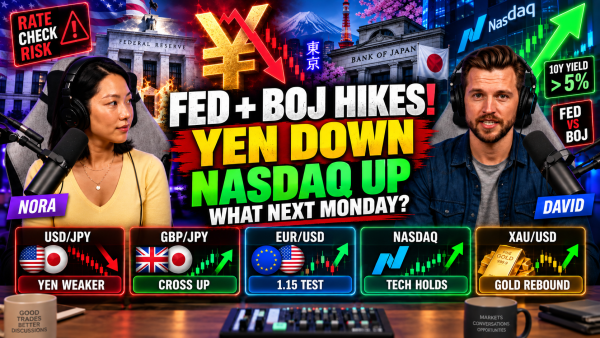
Another volatile week in global financial markets ended with investors confronting a familiar problem: inflation may be more difficult to bring under control than previously expected.
Oil prices surged more than 8%, the U.S. 10-year Treasury yield approached 5%, and the European Central Bank raised interest rates. By Friday, September 11, 2026, financial markets were pricing approximately an 87% probability of another Federal Reserve rate hike.
At the same time, the Japanese yen strengthened for a second consecutive week despite increasingly hawkish U.S. monetary-policy expectations. Gold struggled to maintain its safe-haven appeal, while the Nasdaq remained caught between enthusiasm surrounding artificial intelligence and the pressure created by rising bond yields.
These developments may appear to be separate market stories, but they share an important connection.
Oil was one of the central drivers of the week.
Higher energy prices increased concerns about inflation, influenced bond yields, strengthened expectations for additional central-bank tightening, and placed pressure on equity valuations. Meanwhile, the geopolitical tensions supporting oil prices also created potential safe-haven demand for gold.
This weekly Forex market analysis examines the major developments in USD/JPY, GBP/JPY, EUR/USD, the Nasdaq, gold, and oil, along with the economic and monetary-policy events traders were preparing for during the week beginning September 14, 2026.
All prices, market probabilities, and directional scenarios reflect the historical market snapshot covered in this report, not live quotations or current trading recommendations.
Weekly market takeaway: Oil above $100, inflation concerns, rising Treasury yields, and increasingly hawkish central banks created a difficult environment for risk assets. The yen's continued strength added another important development: investors were beginning to question the long-standing assumptions behind yen-funded carry trades.
Oil Prices Put Inflation Back at the Center of Global Markets
Energy markets were among the most important sources of volatility during the week.
Brent crude gained more than 8% as conflict in the Middle East and risks to major shipping routes continued to influence expectations for global energy supply.
At one point, Brent approached $110 per barrel before retreating to approximately $104.61 on Friday. West Texas Intermediate (WTI) finished near $100.05.
These are significant levels because rising oil prices can affect financial markets far beyond the energy sector.
Higher crude prices can increase transportation expenses, manufacturing costs, and the prices consumers pay for fuel and other goods. If those pressures persist, they can influence inflation expectations and complicate central-bank decisions.
How Higher Oil Prices Affect Interest-Rate Expectations
Central banks do not respond mechanically to every change in energy prices. They consider underlying inflation, economic activity, employment, expectations, and the risk that temporary price shocks will spread into broader inflation.
However, a sustained increase in oil prices can make policymakers more cautious about declaring victory over inflation.
That creates a chain of potential market effects:
- Higher energy prices can increase headline inflation and inflation expectations.
- Persistent inflation concerns can strengthen expectations for additional central-bank tightening.
- Higher expected policy rates can push bond yields upward.
- Rising yields can pressure growth-oriented equities and other interest-rate-sensitive assets.
- Currency markets may reprice relative interest-rate advantages.
- Gold can receive geopolitical support while simultaneously facing pressure from higher yields.
This explains why oil was so important throughout the week. A development in the energy market was influencing several different asset classes through the broader inflation and monetary-policy outlook.
U.S. Inflation Strengthens Expectations for Another Federal Reserve Rate Hike
The latest U.S. inflation report reinforced concerns that monetary policy might need to remain restrictive.
Consumer prices increased 0.4% month over month in August, while annual headline inflation reached 3.4%.
Core inflation, which excludes food and energy, slowed to 2.4% year over year. That provided a somewhat more encouraging picture of underlying inflation, but financial markets still interpreted the overall report as relatively hawkish.
The sharp increase in oil prices contributed to concerns that headline inflation could remain elevated or accelerate again.
September Fed Hike Probability Climbs to 86-87%
Before the inflation report, markets were pricing approximately a 72% probability of a September Federal Reserve rate increase of 25 basis points.
Following the release, that probability increased to around 86-87%.
The repricing demonstrated how strongly investors were responding to renewed inflation concerns.
The U.S. 10-year Treasury yield also climbed toward 4.99%, bringing the psychologically important 5% threshold into focus.
Why a 5% Treasury Yield Matters for the Nasdaq
When government bond yields rise substantially, investors can obtain greater income from assets generally perceived as lower risk than equities.
Higher yields can also increase the discount rates applied to future corporate earnings, which is especially relevant for highly valued growth companies.
Technology stocks often depend on expectations of strong earnings expansion over many years. When the discount rate rises, the present value investors assign to those expected future profits can decline.
This does not mean the Nasdaq must fall whenever Treasury yields increase. Strong earnings and improving growth expectations can offset some of that pressure.
However, a sustained move above 5% in the U.S. 10-year yield could become a significant challenge for equity valuations.
Federal Reserve watch: August headline CPI reached 3.4%, and the market-implied probability of a September 25-basis-point Fed hike increased to approximately 86-87%. With the U.S. 10-year Treasury yield near 5%, monetary policy has become a major influence on currencies, gold, and technology stocks.
USD/JPY: The Japanese Yen Strengthens Despite a More Hawkish Fed
USD/JPY delivered one of the most interesting currency-market performances of the week.
The pair declined from approximately 156.26 to 154.36, representing a weekly fall of around 1.2%.
At one point, USD/JPY traded near 152.90 before recovering part of its losses.
The Japanese yen therefore strengthened against the dollar for a second consecutive week.
What makes this development particularly noteworthy is that U.S. monetary-policy expectations were becoming more hawkish at the same time.
Under ordinary circumstances, higher expected U.S. rates can support USD/JPY by increasing the relative yield appeal of dollar-denominated assets.
But during this week, developments on the Japanese side proved more influential.
Japanese Growth and Wage Data Support Further BOJ Tightening
Better-than-expected Japanese economic growth and wage data increased expectations that the Bank of Japan could continue raising interest rates.
That matters because Japan's relatively low interest-rate environment has been central to the attractiveness of yen-funded carry trades.
If Japanese rates rise while investors reconsider how much further U.S. rates can increase, the expected interest-rate differential may become less favorable for holding Short JPY positions.
The result can be increased demand for yen as investors reduce existing positions or reconsider their future exposure.
Carry Trade Unwinding Adds Momentum to Yen Strength
Investors who previously regarded yen weakness as a persistent opportunity are becoming more cautious.
When many market participants hold positions that benefit from a weaker yen, a sustained yen rally can trigger a broader process of position reduction.
For example, closing Long USD/JPY, GBP/JPY, or AUD/JPY positions involves buying back Japanese yen exposure.
If many investors reduce similar positions simultaneously, that demand can reinforce the yen's appreciation.
Currency intervention risk also remains present, as Japanese authorities continue emphasizing the importance of exchange-rate stability.
However, the key development is that yen strength may increasingly reflect changing Japanese monetary-policy expectations rather than intervention fears alone.
The yen is no longer being evaluated simply as a permanently cheap funding currency. Investors are increasingly questioning how the economics of carry trading could change if Japanese interest rates continue rising.
USD/JPY Monday Outlook: Mildly Bearish Below 154
The short-term outlook for USD/JPY remains mildly bearish following the yen's second consecutive week of gains.
If the pair stabilizes below 154.00, the 153.00 area could return to focus.
A deeper decline could bring the 152.90 region, already tested during the week, back into consideration.
However, the upcoming Federal Reserve decision remains an important counterweight to yen strength.
If the market becomes even more convinced that U.S. rates will rise, the resulting demand for dollars could slow or temporarily reverse the decline in USD/JPY.
A sustained recovery above 155.00 would suggest that the immediate momentum behind the yen rally is beginning to weaken.
The most important question is whether further Bank of Japan tightening expectations continue to outweigh the increasingly hawkish outlook for the Federal Reserve.
GBP/JPY: Yen Strength Overwhelms Better UK Economic Data
GBP/JPY also experienced another difficult week.
The pair fell from approximately 211.22 to 208.56, losing roughly 1.3%.
Once again, the main driver was yen strength rather than a significant deterioration in the British pound's domestic economic outlook.
In fact, British economic data surprised positively.
UK Economic Growth Beats Expectations
The UK economy expanded 0.4% in July, compared with expectations for no growth.
The services sector also grew by 0.4%, providing additional evidence of resilience in an important part of the British economy.
Ordinarily, stronger economic activity could support sterling, particularly if it encourages investors to expect relatively tighter Bank of England policy.
However, during this week the yen's strength was powerful enough to offset that support.
High Oil Prices Complicate the Bank of England Outlook
The Bank of England faces a difficult combination of inflation risks and elevated borrowing costs.
Higher energy prices can intensify inflation pressure, potentially limiting the central bank's flexibility to ease financial conditions.
At the same time, British government bond yields remained high.
The UK 10-year yield was close to 5.4%, while the 30-year yield approached 6%.
These elevated yields can increase financing pressure on households, businesses, and public finances.
The central bank therefore faces a difficult trade-off: containing inflation without placing unnecessary additional pressure on economic activity.
GBP/JPY Monday Outlook: Neutral to Bearish Near 208
The short-term outlook remains neutral to bearish.
If GBP/JPY breaks below 208.00, the 207.10 region could become relevant again.
However, the cross has already experienced a significant decline, and a technical rebound remains possible.
If the pound continues benefiting from stronger domestic data while yen appreciation temporarily pauses, GBP/JPY could recover toward 209.00-210.00.
For now, the Japanese side of the currency pair appears more influential than the British economic narrative.
Traders should therefore monitor Bank of Japan expectations and the broader unwinding of yen-funded positions alongside UK data.
EUR/USD: The ECB and Fed Deliver Competing Hawkish Signals
EUR/USD remained relatively stable despite another important European monetary-policy development.
The European Central Bank raised interest rates by 25 basis points during the week.
Its accompanying message remained relatively hawkish, particularly because rising energy costs could keep inflation above the ECB's 2% target for longer than previously anticipated.
Markets also increased expectations for another ECB rate hike later in the year.
Normally, a more hawkish European Central Bank could provide meaningful support for the euro.
However, EUR/USD failed to develop a significant rally.
By Friday, the pair traded near 1.1595 and was slightly lower over the week.
Why the Euro Did Not Rally After the ECB Hike
The main reason was that U.S. monetary-policy expectations were moving in a similar direction.
While the ECB raised rates and warned about inflation, the U.S. CPI report pushed the probability of another Federal Reserve hike close to 87%.
This left EUR/USD caught between two central banks delivering increasingly restrictive messages.
In currency markets, relative expectations often matter more than the absolute direction of one central bank's policy.
If both the ECB and Fed become more hawkish at approximately the same time, the exchange-rate impact depends on which shift is more significant relative to what investors had already anticipated.
Two hawkish central banks do not automatically produce a strong trend in either direction. They can also create a relatively balanced currency market.
EUR/USD Monday Outlook: Neutral Around 1.16
The short-term outlook for EUR/USD remains neutral.
The 1.1600 level is the main technical reference.
A sustained move above that area could bring 1.1650 back into focus.
On the downside, a break below approximately 1.1580 could reopen the broader 1.1500-1.1550 region.
Given the competing Fed and ECB narratives, sideways trading may remain more plausible than a clean directional trend until new information produces a clearer relative interest-rate advantage.
The next major catalyst could be a change in U.S. rate expectations or a new signal about the ECB's willingness to tighten policy further.
Nasdaq: Friday's Rebound Cannot Eliminate the Bond-Yield Problem
The Nasdaq ended the week with a positive Friday session but remained under pressure on a weekly basis.
The Nasdaq Composite gained 0.96% on Friday and closed at 26,333.04.
Despite that rebound, the index finished the full week approximately 0.7% lower.
The recovery was helped by a pullback in oil prices and encouraging corporate developments in the technology sector.
Oracle Results Support the AI Infrastructure Narrative
Strong corporate results from Oracle reinforced the idea that substantial investment in artificial intelligence infrastructure can generate meaningful revenue growth.
That provided support for investor enthusiasm around AI-related businesses and helped technology shares recover on Friday.
However, positive corporate results were not enough to remove broader macroeconomic concerns.
Rising bond yields remain a significant potential headwind for highly valued technology companies.
More Than $32 Billion Reportedly Leaves U.S. Equity Funds
According to the fund-flow figures referenced in the analysis, more than $32 billion flowed out of U.S. equity funds during the week ending September 9.
That represented the largest weekly outflow in nine months.
Such flows do not automatically determine the next direction of the equity market, but they illustrate the caution developing among investors.
The concerns are interconnected:
- Oil prices remained elevated.
- Inflation appeared more persistent than expected.
- Government bond yields increased.
- Further Federal Reserve tightening became more likely.
- Equity valuations faced additional pressure from higher discount rates.
The Nasdaq therefore remained caught between improving expectations for AI-related corporate earnings and a more difficult interest-rate environment.
Nasdaq Monday Outlook: Mildly Bullish, but Watch the 5% Yield Level
Friday's technically positive close supports a neutral to mildly bullish short-term outlook.
If oil continues moving lower and Treasury yields retreat, technology stocks could extend the recovery.
However, a sustained move above 5% in the U.S. 10-year Treasury yield would weaken the bullish scenario.
At that point, investors may become more concerned about the relative attractiveness of bonds and the valuation pressure facing growth stocks.
The immediate question is whether the market can maintain enthusiasm for AI-related earnings while adjusting to the possibility of another Federal Reserve rate increase.
Nasdaq risk: Friday's 0.96% rebound was constructive, but the index still lost approximately 0.7% for the week. A sustained U.S. 10-year Treasury yield above 5% could challenge technology valuations despite strong AI-related corporate results.
Gold: Geopolitical Safe-Haven Demand Competes With Rising Yields
Gold experienced another volatile trading week as two powerful forces pulled the market in opposite directions.
On one side, geopolitical uncertainty remained elevated.
Risks surrounding the Strait of Hormuz and deteriorating security near the Bab el-Mandeb shipping route created a potentially supportive environment for traditional safe-haven assets.
On the other side, rising U.S. interest-rate expectations and higher bond yields increased the opportunity cost of holding gold.
The result was an unstable market that struggled to sustain upward momentum.
Gold Falls Nearly 2% on Thursday
Gold declined almost 2% on Thursday as higher inflation pressure reinforced expectations of additional Federal Reserve tightening.
However, buyers returned on Friday and pushed spot gold back above approximately $4,360.
Despite that recovery, the metal finished the week roughly 1.5% lower.
Why Geopolitical Risk Is Not Always Enough to Support Gold
Gold often attracts demand during periods of geopolitical instability because investors may regard it as a store of value or portfolio hedge.
However, that demand is only one influence on its price.
When nominal and real interest rates rise, assets that provide yield can become more attractive relative to gold, which generates no interest income.
A stronger U.S. dollar can create additional pressure.
This explains why gold can decline even when geopolitical uncertainty is high. The safe-haven argument may remain present, but other forces can dominate the immediate market reaction.
Gold is caught between geopolitical and inflation-related support on one side and higher interest-rate opportunity costs on the other.
Gold Monday Outlook: Neutral to Mildly Bullish Above $4,350
The short-term gold outlook is neutral to mildly bullish while the $4,350-4,360 support area continues to hold.
If buyers maintain that region, the next upside levels of interest are approximately $4,400 and then $4,430.
However, a decline below $4,300 would materially weaken the technical picture.
The outlook remains highly sensitive to changing interest-rate expectations and geopolitical developments.
A renewed rise in U.S. yields could limit recovery attempts, while an unexpected escalation in the Middle East could generate additional demand for safe-haven exposure.
U.S. Consumer Sentiment Adds Another Inflation Warning
The economic effects of higher energy prices are not limited to financial markets.
Consumer sentiment also weakened during the period covered by the report.
The University of Michigan consumer sentiment index declined from 51.7 in August to 47.8 in September.
At the same time, one-year inflation expectations increased from 4% to 4.6%.
This combination is important because it points toward weaker consumer confidence alongside rising concerns about future prices.
Why Inflation Expectations Matter for Central Banks
Central banks monitor inflation expectations because they can influence wage negotiations, spending decisions, pricing behavior, and broader economic confidence.
If households and businesses increasingly expect higher inflation, those expectations may contribute to more persistent price pressures.
This does not mean survey expectations automatically translate into actual inflation. However, a sustained increase can make monetary policymakers more cautious.
When consumer sentiment weakens while inflation expectations rise, the economic outlook becomes particularly challenging.
Lower confidence can indicate pressure on future spending, while higher expected inflation can reduce the central bank's flexibility to support growth through lower interest rates.
This creates another reason the Federal Reserve's upcoming guidance may be as important as the immediate interest-rate decision.
Monday Market Outlook at a Glance
The following table summarizes the conditional scenarios identified at the end of Friday, September 11, for the beginning of the next trading week.
| Market | Short-term outlook | Key levels and conditions |
|---|---|---|
| USD/JPY | Mildly bearish | Below 154.00, watch 153.00 and 152.90. Above 155.00, the bearish momentum could weaken. |
| GBP/JPY | Neutral to bearish | Below 208.00, watch 207.10. A rebound toward 209.00-210.00 remains possible. |
| EUR/USD | Neutral | 1.1600 is the key dividing line. Above it, watch 1.1650. Below 1.1580, watch 1.1550-1.1500. |
| Nasdaq | Neutral to mildly bullish | Friday's rebound supports the near-term picture, but a sustained U.S. 10-year yield above 5% would be a warning. |
| Gold | Neutral to mildly bullish | Above $4,350-4,360, watch $4,400 and $4,430. Below $4,300, the technical picture weakens. |
These scenarios describe potential market developments rather than guaranteed outcomes. Weekend headlines, central-bank communication, and changes in liquidity could invalidate them before or during Monday's trading session.
Next Week: Federal Reserve and Bank of Japan Decisions Take Center Stage
The coming week places monetary policy back at the center of attention.
Following the latest inflation figures, markets were assigning approximately an 87% probability to a 25-basis-point Federal Reserve rate increase.
However, the decision itself may not be the only important market catalyst.
Federal Reserve: The Outlook After the Rate Decision Matters
If the Federal Reserve raises rates as the market largely expects, investors will likely focus on what policymakers say about the future path of monetary policy.
Will the central bank signal that further increases remain possible? Or will it suggest that the latest adjustment may be sufficient if inflation starts cooling?
Those differences could materially influence Treasury yields, currency markets, gold, and equities.
A widely expected decision does not necessarily generate a large market movement on its own. The reaction often depends on how the outcome and accompanying guidance compare with what investors had already priced in.
Bank of Japan: September 17-18 Meeting
Japan will also be closely watched when the Bank of Japan meets on September 17-18.
Recent yen strength shows that investors are taking the possibility of additional monetary tightening seriously.
However, there are at least two plausible responses to the meeting.
If the BOJ raises interest rates but communicates cautiously about additional increases, the yen could experience a so-called buy the rumor, sell the fact reaction.
In that scenario, traders who positioned for a hawkish decision may take profits if the accompanying guidance proves less restrictive than expected.
Alternatively, if the BOJ signals that further interest-rate increases are likely, the unwinding of yen-funded carry trades could continue.
That could place additional pressure on USD/JPY, GBP/JPY, and other yen crosses.
The ECB Is Also Part of the Same Repricing
The European Central Bank has already increased rates during the week, and markets are evaluating whether additional tightening could follow.
This creates an important broader pattern.
The Fed, ECB, and BOJ are all facing upward interest-rate pressure at approximately the same time.
That is very different from an environment where investors focus primarily on which central bank will begin cutting interest rates first.
Relative expectations remain essential for Forex because exchange rates are influenced by differences in monetary-policy paths, not merely whether one central bank raises rates in isolation.
Next week's central-bank focus: The Fed is approaching a decision with another hike heavily priced in, while the BOJ meets on September 17-18 after two weeks of yen strength. The guidance accompanying these decisions could matter more than the rate changes themselves.
Weekend Geopolitical Risk: Strait of Hormuz and Bab el-Mandeb
Monetary policy is not the only source of uncertainty heading into Monday.
Geopolitical developments around the Strait of Hormuz remain particularly important because of the route's significance for global energy transportation.
Security concerns have also intensified around the Bab el-Mandeb shipping route, creating additional uncertainty over maritime trade and supply conditions.
At the same time, reports referenced in the analysis suggested that Middle Eastern governments were exploring temporary arrangements related to shipping security and Iran.
Two Very Different Oil Market Scenarios
If diplomatic efforts produce meaningful de-escalation, investors may begin reducing the geopolitical risk premium embedded in crude prices.
That could push oil lower, ease some inflation concerns, and support equities by reducing fears of further monetary tightening.
However, renewed attacks or a further escalation could produce the opposite response.
Oil prices could rise again, inflation concerns could intensify, and investors might become more cautious about risk-sensitive assets.
Gold could also react to safe-haven demand, although any resulting increase in bond yields or dollar strength could complicate that reaction.
This creates substantial uncertainty for positions held over the weekend.
A strategy that appears comfortable based on Friday's closing prices may face a different environment when markets reopen, particularly if weekend developments cause gaps, spread widening, or sudden changes in liquidity.
Weekend risk is not limited to the direction of prices. For leveraged traders, execution conditions and the combined exposure of the portfolio can be equally important.
Why Analyzing One Market in Isolation Can Be Misleading
One of the clearest lessons from the week is that major financial markets are increasingly connected through shared economic developments.
USD/JPY is influenced by the relative monetary-policy outlooks of the Federal Reserve and Bank of Japan.
EUR/USD reflects changing expectations for both the Fed and European Central Bank.
Gold responds to the interaction between geopolitical uncertainty, the dollar, inflation expectations, and nominal and real yields.
The Nasdaq balances enthusiasm around artificial intelligence and corporate earnings against the effect of higher interest rates on valuations.
Oil influences inflation expectations, which can feed back into bond markets, monetary policy, and the wider financial system.
One Development Can Have Opposite Effects Across Different Assets
Consider a sustained increase in crude prices.
It can support energy producers while increasing costs for companies that consume substantial energy. It can raise inflation expectations and strengthen the case for tighter monetary policy.
Higher yields may support a currency through relative interest-rate advantages while pressuring growth-oriented equities.
Gold may benefit from increased geopolitical anxiety but struggle because holding it becomes less attractive when yields rise.
These relationships are not mechanical, and different influences can dominate at different times.
That is why understanding the economic reasons behind a market movement can be just as important as identifying its direction on a chart.
What These Developments Mean for Automated Forex Trading at SignalCrumbs
At SignalCrumbs, we pay close attention to interest-rate differentials, market trends, volatility, and broader monetary-policy expectations because they can influence the environment in which our own automated Forex trading system operates.
This is especially relevant to carry-trade strategies.
When investors expect one currency to offer substantially higher interest rates than another, the differential can create a reason to hold certain currency positions over longer periods.
However, those relationships can change.
A more hawkish Bank of Japan can alter the attractiveness of yen-funded trades, while additional Federal Reserve tightening can influence the relative yield appeal of the U.S. dollar.
At the same time, currency intervention risk, changing volatility, and correlated exposure can create substantial drawdowns even when the original interest-rate thesis remains plausible.
That is why a complete trading process needs to consider more than entry signals.
Position sizing, Used Margin, Free Margin, Equity, total portfolio exposure, correlations, and changing market regimes all play important roles in risk management.
Automation can help apply predefined rules consistently, but it does not eliminate uncertainty or ensure that historical market relationships will remain stable.
A trading system should be able to recognize when available account capacity or market conditions do not justify opening additional positions.
At SignalCrumbs.com, we publish educational Forex market analysis and document the activity of our own private proprietary automated trading system, including its opened and closed positions.
The aim is to understand the relationship between systematic trading logic, market conditions, and practical risk management rather than treat any one market forecast as certain.
Sometimes the appropriate response to a changing environment is accepting a valid opportunity. At other times, it is waiting for better conditions or reducing exposure.
No Trade can be the correct decision when an otherwise interesting setup does not fit the risk requirements of the portfolio.
Final Thoughts
The trading week ending September 11, 2026, demonstrated that the global inflation story was far from settled.
Oil climbed more than 8%, with Brent closing near $104.61 and WTI around $100.05. U.S. headline inflation reached 3.4%, and the 10-year Treasury yield moved close to the important 5% threshold.
Markets increased the probability of another Federal Reserve rate hike to approximately 87%, while the European Central Bank had already raised interest rates and investors were preparing for a potentially significant Bank of Japan decision.
Those developments created a different trading environment from one dominated by expectations of monetary easing.
USD/JPY declined for a second consecutive week as stronger Japanese economic data and Bank of Japan tightening expectations supported the yen, even against the backdrop of a more hawkish Federal Reserve.
GBP/JPY also weakened despite better-than-expected British growth, showing how yen-related developments can dominate the short-term performance of multiple currency pairs.
EUR/USD remained close to 1.16 because both the ECB and Fed were delivering increasingly hawkish signals, limiting the immediate directional advantage of either currency.
The Nasdaq recovered on Friday thanks partly to lower oil prices and encouraging Oracle results, but rising Treasury yields and significant equity fund outflows continued to create reasons for caution.
Gold remained caught between geopolitical safe-haven demand and the higher opportunity cost created by rising interest rates. Its short-term direction may depend on whether yields or geopolitical developments become the dominant influence.
Heading into the next week, the Federal Reserve and Bank of Japan will be especially important. Investors will be watching not only whether rates change, but also what policymakers signal about further tightening.
Meanwhile, geopolitical developments involving Iran, the Strait of Hormuz, and Bab el-Mandeb could change the oil market and the wider inflation outlook before Monday's session begins.
The central lesson is that markets cannot always be understood by looking at one chart in isolation. Oil, inflation, interest rates, currencies, equities, and gold are connected through shared economic forces.
For traders, recognizing those connections can help distinguish a short-term technical move from a broader change in the fundamental environment.
It can also improve risk awareness when several positions are exposed to the same monetary-policy or geopolitical development.
None of the scenarios discussed here is guaranteed. The market can reprice expectations again, and a single unexpected event may quickly invalidate the outlook established at the end of the week.
The objective is not to predict every market movement perfectly. It is to understand the forces influencing prices, recognize when assumptions are changing, and manage exposure according to a repeatable process.
 Related posts