Global financial markets ended another turbulent week with an unusual combination of economic signals. The U.S. labor market showed significant signs of weakness, expectations for another Federal Reserve interest-rate increase collapsed, and yet long-term Treasury yields remained close to their highest levels in more than two decades.
The global bond selloff intensified, EUR/USD extended its losing streak, and gold declined more than 3% despite persistent geopolitical uncertainty. Meanwhile, the Nasdaq moved higher again, supported by artificial intelligence investment expectations and enthusiasm surrounding major technology companies.
Friday's U.S. Nonfarm Payrolls report delivered the most important economic surprise of the week. The economy added just 29,000 jobs in September, substantially below expectations of 90,000, while unemployment increased and wage growth slowed.
Under normal circumstances, such weak employment data might be expected to reduce bond yields, weaken the dollar, and provide substantial support for gold and equities. Some of those reactions appeared immediately after the report, but they did not all last.
That is what makes this week's market behavior particularly interesting.
The Federal Reserve's near-term interest-rate outlook changed dramatically, but the broader bond-market problem did not disappear.
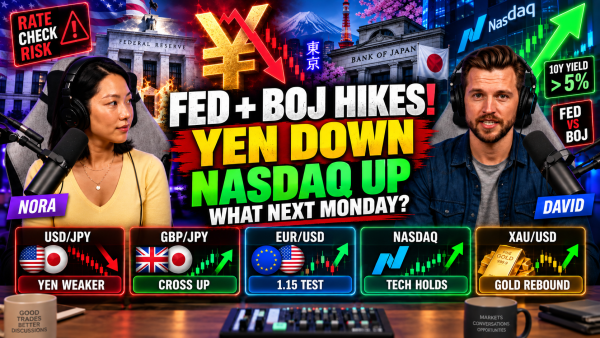
In this weekly Forex market analysis, we examine the developments affecting USD/JPY, GBP/JPY, EUR/USD, the Nasdaq, and gold, together with the role of energy prices, government borrowing concerns, and changing central-bank expectations.
We also outline the technical levels and conditional scenarios that were relevant for Monday, October 5, 2026. All figures and expectations reflect the market information available around Friday, October 2, 2026, rather than live market quotations.
Weekly market takeaway: Weak U.S. employment data sharply reduced expectations for another October Fed rate hike, but the 10-year Treasury yield remained near 5.3%. The divergence suggests that markets are pricing more than the next monetary-policy decision, including inflation, energy, government borrowing, and longer-term fiscal risks.
U.S. Nonfarm Payrolls: Just 29,000 Jobs Added in September
Friday's U.S. employment report was the clearest economic surprise of the week.
According to the figures referenced in the analysis, the United States added only 29,000 nonfarm payroll jobs in September, compared with the 90,000 expected by economists surveyed by Reuters.
The weakness was not limited to the latest monthly figure.
Employment growth for July and August was revised down by a combined 60,000 jobs, indicating that the labor market had been softer than previously reported.
The unemployment rate increased from 4.1% to 4.2%, while annual wage growth slowed to approximately 3.0%.
Why the Employment Report Was So Important
The Federal Reserve must evaluate inflation alongside employment and broader economic conditions when deciding how restrictive monetary policy should remain.
When hiring slows sharply, the argument for additional interest-rate increases becomes more complicated. Higher rates can reduce demand and inflation pressure, but they can also place further stress on an already weakening labor market.
Before the release, investors had been considering the possibility that the Federal Reserve would need to raise rates again in October because inflation remained elevated.
The September employment figures changed that assessment almost immediately.
October Fed Rate Hike Expectations Collapse
Only one week earlier, the market had assigned roughly a 64% probability to another Federal Reserve rate increase in October.
Following Friday's employment report, the probability of a hike fell to approximately 22% in the market pricing referenced by the analysis.
Another probability measure cited toward the end of the week suggested that markets assigned around an 86% probability to no increase in October.
These figures describe different quoted market snapshots or probability measures and should not be interpreted as exact complements of one another.
The broader conclusion is clear: investors became substantially less convinced that the Federal Reserve would raise rates again at its next meeting.
However, that does not mean the tightening cycle was definitively over. Some policymakers could still consider another increase later in the year, particularly if energy-driven inflation remained persistent.
Friday's NFP report significantly weakened the case for an immediate rate hike, but it did not eliminate the Federal Reserve's broader inflation concerns.
Why U.S. Treasury Yields Stayed High Despite Weak Employment
The bond market delivered one of the most important signals of the week.
On Thursday, the U.S. 10-year Treasury yield climbed as high as 5.34%, reaching its highest level since 2002, according to the period covered in the report.
When Friday's weak employment numbers were released, yields initially moved lower.
That reaction made sense. Weaker hiring reduced expectations for further near-term Federal Reserve tightening, which would ordinarily support bond prices and push yields down.
But the decline did not last.
The 10-year yield recovered and moved back toward approximately 5.28%.
Long-Term Treasury Yields Are Not Controlled by One Fed Meeting
The yield on a 10-year government bond reflects a much broader set of expectations than the probability of an interest-rate change at the next Federal Reserve meeting.
Investors consider the expected path of short-term rates over many years, inflation uncertainty, fiscal conditions, government borrowing, and the compensation required for holding long-duration bonds.
Elevated energy prices can add to inflation concerns, while large financing requirements and uncertainty surrounding government debt can influence the return investors demand from longer-term securities.
As a result, the market can simultaneously price a lower probability of a near-term Fed hike and maintain elevated long-term bond yields.
That is precisely the tension highlighted by this week's trading.
Why the Divergence Matters for Other Assets
High Treasury yields can continue supporting the relative attractiveness of the dollar even when near-term Federal Reserve expectations become less hawkish.
They can also pressure gold by increasing the opportunity cost of holding an asset that produces no interest income.
For technology stocks, elevated yields increase the discount rate applied to expected future corporate profits, creating a valuation challenge.
Therefore, a reduction in October rate-hike expectations does not automatically produce lower long-term yields, a weaker dollar, higher gold prices, and a stronger stock market simultaneously.
Different parts of the financial market can respond to different aspects of the same economic report.
Bond-market divergence: The U.S. 10-year Treasury yield reached 5.34% before recovering toward 5.28% after Friday's employment report. The persistence of high long-term yields suggests that inflation, energy prices, fiscal concerns, and borrowing requirements remain important beyond the next Fed decision.
USD/JPY: High U.S. Yields Compete With Bank of Japan Tightening Expectations
USD/JPY finished the week with a relatively small gain, despite the substantial shift in expectations for Federal Reserve policy.
The pair traded around 157.80 on Friday evening, compared with approximately 157.30 one week earlier.
That represented a weekly increase of around 0.3%, putting USD/JPY on course for its third consecutive positive week.
Friday's weak employment report initially supported the Japanese yen, and the dollar declined approximately 0.15% against it during the session.
However, the broader pressure on the yen had not disappeared.
Why High U.S. Treasury Yields Still Support USD/JPY
Even though the probability of another near-term Fed rate hike fell, U.S. long-term Treasury yields remained extremely elevated.
That can preserve the attractiveness of dollar-denominated fixed-income assets relative to comparable investments in lower-yielding currencies.
For carry-trade strategies, relative yield differences remain an important consideration, although actual financing returns depend on broker swap conditions, currency movements, and execution costs.
Japan also faces an additional challenge: high energy prices.
As a major energy-importing economy, Japan can experience pressure from rising oil and gas costs. Higher energy import expenses may influence its trade balance, domestic inflation, and overall economic outlook.
Those factors can complicate the yen's response to global developments.
Tokyo Inflation Keeps BOJ Tightening in Focus
Domestic Japanese inflation data provided an opposing influence.
Tokyo core inflation accelerated in September to its fastest pace in ten months, strengthening expectations that the Bank of Japan could need to tighten monetary policy further.
Higher expected Japanese rates can reduce the relative attractiveness of funding positions in yen and support the currency.
This means USD/JPY is currently influenced by two competing interest-rate stories:
- United States: Extremely high long-term bond yields continue offering support for the dollar.
- Japan: Stronger inflation increases the possibility of additional BOJ tightening.
- Energy markets: Elevated import costs create complications for the Japanese economy.
- Intervention risk: Further yen weakness could renew attention from Japanese authorities.
The resulting market environment is less straightforward than simply buying or selling USD/JPY according to the next Federal Reserve decision.
USD/JPY Monday Outlook: Neutral Between 157 and 158
The short-term technical picture remains relatively neutral.
A sustained move above 158.00 could bring 159.00 back into focus.
However, higher exchange-rate levels would also increase sensitivity to intervention-related headlines, making a bullish continuation potentially more vulnerable to sudden reversals.
On the downside, a break below 157.00 could indicate that falling near-term Fed expectations and renewed Japanese tightening concerns are beginning to support the yen more decisively.
In that scenario, approximately 156.00 becomes the next important area to monitor.
The key issue is whether elevated U.S. Treasury yields can continue supporting the dollar despite signs of deterioration in the American labor market.
GBP/JPY: An Almost Flat Week Conceals Significant Volatility
GBP/JPY ended the week near its starting level, but that does not mean market conditions were calm.
The cross traded around 208.40-208.50 on Friday evening, approximately where it had finished the previous week.
During the week, however, price movements were much larger.
On Wednesday, GBP/JPY declined toward approximately 206.90. By Thursday, it had recovered to almost 210.00.
Those movements reflected uncertainty surrounding monetary policy, bond yields, and the economic outlook in both the United Kingdom and Japan.
UK Government Bond Yields Reach Multi-Decade Highs
British government bonds were under substantial pressure.
The UK 30-year government bond yield moved above 6% on Thursday, reaching a level not seen since 1998.
The UK 10-year yield also climbed to its highest level since 2007 before easing somewhat on Friday as oil prices retreated.
Rising government bond yields can reflect expectations for tighter monetary policy, persistent inflation, fiscal uncertainty, or broader concerns about financing conditions.
For the United Kingdom, the combination of elevated energy costs and high borrowing rates creates a challenging environment.
UK Companies Still Expect Significant Price Increases
The Bank of England's corporate survey referenced in the analysis showed that British companies expected prices to increase approximately 3.7% over the following 12 months.
Expected wage growth remained around 3.4%.
These figures suggest that inflation pressures were still relevant to business planning, even as elevated financing costs placed pressure on the economy.
Markets therefore continued considering the possibility of another Bank of England interest-rate increase in November.
Higher expected British rates can support sterling, but the broader economic situation is not automatically positive for the currency.
If tightening becomes necessary because energy costs and inflation remain elevated while economic activity weakens, investors may view the situation less favorably.
GBP/JPY Monday Outlook: Neutral to Mildly Bearish Below 208.5
GBP/JPY remains neutral to mildly bearish below approximately 208.50.
If the cross falls below 208.00, attention could shift toward 207.00, followed by the 206.90 area already tested during the week.
Alternatively, a recovery above 209.00 would bring 210.00 into focus.
The Japanese yen may ultimately determine the next significant movement.
If markets increase expectations for further BOJ tightening, or if global risk sentiment deteriorates and investors reduce yen-funded exposure, GBP/JPY could face renewed pressure.
Conversely, renewed weakness in the yen could allow the cross to recover despite uncertainty surrounding the UK economy.
EUR/USD: Four Consecutive Losing Weeks for the Euro
EUR/USD displayed a much clearer weekly direction than GBP/JPY.
The pair traded near 1.1260 on Friday, compared with approximately 1.1390 one week earlier.
That represented a weekly decline of roughly 1.1%.
It also marked the euro's fourth consecutive losing week against the dollar, its longest negative streak since May 2025 according to the source analysis.
Friday's weak U.S. employment report allowed the euro to recover from its intraday low, but the rebound was insufficient to reverse the broader weekly trend.
The problem for EUR/USD was not limited to dollar strength. European financial conditions also presented significant challenges.
European Bond-Market Stress Adds Pressure to EUR/USD
One of the most concerning developments involved the French government bond market.
On Thursday, France's 10-year government bond yield climbed to its highest level since 2002.
By Friday, the yield difference between French and German 10-year government bonds had widened above 150 basis points, the largest spread since 2011 in the figures referenced by the analysis.
That widening reflected substantial tension within European sovereign bond markets.
Why the French-German Yield Spread Matters
The yield spread between two countries' government bonds can provide information about investors' perceptions of relative fiscal risk, liquidity, and financing conditions.
Germany is widely used as an important benchmark within eurozone bond markets.
When French borrowing costs rise sharply relative to German yields, investors may be demanding greater compensation for holding French government debt.
Such a development can influence broader perceptions of eurozone financial stability and the attractiveness of euro-denominated assets.
However, the spread alone does not establish the exact cause of the movement. Fiscal concerns, risk sentiment, market liquidity, and other factors may all contribute.
Higher Energy Prices Create Another European Problem
Europe also remains vulnerable to elevated energy costs.
Higher prices can increase inflation while simultaneously placing pressure on industrial activity, businesses, and household purchasing power.
That can create an uncomfortable situation for the European Central Bank.
Rising inflation may strengthen expectations for additional tightening, but higher interest rates can add pressure to an economy already facing unfavorable energy and financing conditions.
Normally, relatively higher interest-rate expectations can support a currency.
But rate increases driven by energy-related inflation during a period of weakening growth do not necessarily create an attractive overall investment environment.
The euro is facing more than a strong dollar. European government bond stress, high energy costs, inflation uncertainty, and weaker recent price momentum are all contributing to the difficult outlook.
EUR/USD Monday Outlook: Mildly Bearish Near 1.12-1.125
The short-term outlook remains mildly bearish.
The 1.1200-1.1250 region is an important support area.
A convincing break beneath that zone could expose the possibility of another low for 2026.
However, the sharp reduction in expectations for an October Federal Reserve rate increase introduces an important counterweight.
If weaker U.S. labor-market data continue influencing monetary-policy expectations and EUR/USD manages to recover above 1.1300, a technical correction could develop.
For now, however, the euro remains under pressure from several directions: U.S. long-term yield strength, European fiscal concerns, elevated energy costs, and four consecutive weeks of negative price momentum.
Nasdaq: Technology Stocks Rise Despite Treasury Yields Above 5.3%
The Nasdaq continued telling a very different story from the bond market.
On Friday, the Nasdaq Composite gained 1.19% and closed at 27,190.86.
That left the index approximately 0.45% higher for the week, marking its fifth positive week out of the previous six.
This resilience was particularly notable because the U.S. 10-year Treasury yield had traded above 5.3% during the same week.
Rising yields generally create challenges for equity valuations, especially for companies whose value depends heavily on expected future earnings growth.
Yet investor enthusiasm surrounding artificial intelligence and large technology companies continued supporting the Nasdaq.
Weak NFP Helped Growth Stocks on Friday
Friday's disappointing employment data sharply reduced the probability of another near-term Federal Reserve interest-rate increase.
That encouraged buying in technology and other rate-sensitive shares.
Nvidia advanced approximately 1.3%, while Tesla gained around 4.7%.
Smaller companies that are especially sensitive to financing conditions also benefited from the more cautious Fed outlook.
However, the rebound in equities was not accompanied by a sustained decline in long-term Treasury yields.
That divergence remains an important concern.
Nasdaq Market Breadth: 57 New Highs vs. 224 New Lows
Although the Nasdaq finished Friday higher, the internal market picture was less encouraging.
The exchange recorded:
- 57 new 52-week highs
- 224 new 52-week lows
More stocks advanced than declined during Friday's session, but the large difference between new highs and new lows suggests that the broader market remained under pressure.
This is an important distinction.
A major stock index can continue rising when a relatively small group of large companies generates enough positive performance to outweigh weakness elsewhere.
Because the Nasdaq Composite is market-capitalization weighted, movements in large companies can significantly influence the headline index.
AI Strength Does Not Mean Every Technology Stock Is Healthy
Expectations surrounding artificial intelligence infrastructure, corporate profitability, and long-term technology demand remain powerful sources of investor enthusiasm.
However, the large number of Nasdaq stocks making new lows shows that optimism is not evenly distributed.
A concentrated rally can continue for some time, but it may become more vulnerable if its strongest companies lose momentum.
The interaction with Treasury yields is particularly important.
If borrowing costs continue increasing while the AI leaders begin weakening, the index could face pressure from both valuation concerns and deteriorating leadership.
Nasdaq index strength and broad market health are not necessarily the same thing. A rising headline index can conceal substantial weakness among individual stocks.
Nasdaq divergence: The Nasdaq rose 1.19% on Friday and finished the week 0.45% higher, even as Treasury yields remained near multi-decade highs. However, 57 new 52-week highs against 224 new lows suggest that market leadership was considerably narrower than the headline index performance implied.
Nasdaq Monday Outlook: Mildly Bullish Above 27,000
The short-term outlook remains neutral to mildly bullish while the Nasdaq holds above approximately 27,000.
Friday's momentum was positive, and sharply reduced expectations for another October Fed hike could continue supporting risk sentiment.
If 27,000 remains intact, the index could revisit its recent all-time highs.
However, Treasury yields remain the major risk.
If the U.S. 10-year yield moves back toward the 5.30-5.40% region or rises beyond it, pressure on technology valuations could intensify again.
For the beginning of the week, the relationship between equity prices and government bond yields may be more important than any single technology-sector headline.
Gold: Weak NFP Triggers a Rally That Quickly Fails
Gold experienced one of the most surprising reactions to Friday's employment report.
Spot gold traded near $4,140 per ounce on Friday and declined approximately 3.4% over the week.
U.S. gold futures settled at $4,162.30.
That marked the metal's second consecutive negative week.
Immediately after the weak NFP report, gold initially rose by more than 1%.
The reaction was understandable. A weaker labor market reduced expectations for further near-term Federal Reserve tightening, which can be supportive for a non-yielding asset.
But the rally did not last.
Gold reversed lower and finished the session approximately 1% down.
Why Gold Failed to Hold Its Post-NFP Gains
The failed rally suggested that longer-term market pressures remained more influential than the immediate change in Federal Reserve expectations.
The U.S. 10-year Treasury yield remained elevated near 5.3%, while the dollar continued receiving support from broader financial conditions.
Gold does not generate interest income, so elevated bond yields can increase the opportunity cost of holding it.
This can create selling pressure even when shorter-term economic data would ordinarily appear supportive.
The result was a market in which one weak employment report was insufficient to reverse the broader negative trend.
Why Gold Has Struggled Despite Middle East Geopolitical Risk
According to the historical analysis, gold was more than 20% below its February highs following the intensification of the U.S.-Israel-Iran conflict.
That may seem unusual because gold is often considered a safe-haven asset during geopolitical instability.
However, geopolitical events can affect financial markets through several different mechanisms.
Escalation in the Middle East can increase oil prices and concerns about energy supply.
Higher oil prices may increase inflation expectations, which can encourage markets to price more restrictive monetary policy and demand higher returns from government bonds.
Those higher yields can weigh on gold, even while geopolitical uncertainty creates potential safe-haven demand.
Therefore, a conflict does not automatically produce a sustained gold rally.
Geopolitical uncertainty can support gold through safe-haven demand while simultaneously pressuring it through inflation expectations and higher interest rates.
During this particular week, the negative effects associated with high yields and a relatively strong dollar were more influential than the immediate support from geopolitical risk.
Gold Monday Outlook: $4,100 Becomes a Critical Level
The short-term outlook for XAU/USD remains neutral to mildly bearish.
The psychologically important $4,100 level is a major downside reference.
If that area breaks, the next support could emerge around $4,050, followed by the broader $4,000 region.
On the upside, the first area to watch is approximately $4,160-$4,180.
A stronger recovery could bring $4,200 back into focus.
However, Friday's failed post-NFP rally suggests that buyers still face a difficult environment while long-term Treasury yields remain elevated.
A meaningful improvement in the short-term outlook may require either easing bond-yield pressure, renewed dollar weakness, stronger safe-haven demand, or some combination of those influences.
Oil Prices Remain a Central Driver of the Global Macro Environment
Energy markets continued influencing inflation expectations, bond yields, currencies, and equity-market sentiment.
Oil prices eased somewhat during the second half of the week, while Europe agreed to release diesel reserves.
Those developments helped reduce some pressure on European bond markets on Friday.
However, the broader geopolitical environment remained highly uncertain.
U.S.-Iran Negotiations Remain Unresolved
According to the information referenced in the analysis, negotiations between the United States and Iran remained close to a stalemate.
Reports also pointed to an increased U.S. military presence in the region.
That creates substantial weekend headline risk because new developments could change expectations for energy supply and geopolitical stability.
A diplomatic breakthrough could reduce some uncertainty and push oil prices lower.
Conversely, further escalation could renew supply concerns and increase the geopolitical premium embedded in energy markets.
How Oil Can Influence Several Assets at Once
A substantial oil-price movement can affect:
- Consumer and producer inflation expectations
- Government bond yields
- Federal Reserve and ECB policy expectations
- The U.S. dollar and other major currencies
- Gold and its competing safe-haven and interest-rate influences
- Global equity valuations and risk sentiment
These relationships are not automatic. Markets may respond differently depending on whether investors focus primarily on inflation, economic growth, geopolitical risk, or monetary-policy implications.
Nevertheless, oil remains one of the central connections between the apparently conflicting asset-price movements of this week.
Japan: Energy Costs, Inflation and BOJ Expectations
Japan deserves close attention during the upcoming week.
Japanese corporate sentiment and forthcoming corporate reports may provide additional information about how companies are responding to elevated energy costs and currency movements.
Many Japanese businesses face the combination of relatively expensive imported energy and a yen that remains weak compared with earlier historical periods.
At the same time, Tokyo's stronger September inflation data has reinforced the possibility of further monetary tightening by the Bank of Japan.
That creates uncertainty for yen crosses.
If additional BOJ tightening becomes more likely, investors may reconsider the attractiveness of holding yen-funded carry positions.
However, if U.S. yields remain extremely elevated, the interest-rate differential can continue influencing demand for the dollar against the yen.
For USD/JPY and GBP/JPY, this means Japanese developments could become just as important as U.S. or British economic information.
Monday Market Outlook: Five Instruments at a Glance
The following table summarizes the conditional scenarios identified using the Friday evening market snapshot.
| Market | Short-term outlook | Important levels and conditions |
|---|---|---|
| USD/JPY | Neutral | Above 158.00, watch 159.00. Below 157.00, a move toward 156.00 becomes more plausible. Intervention risk increases at higher levels. |
| GBP/JPY | Neutral to mildly bearish | Below 208.50, watch 208.00, 207.00 and 206.90. Above 209.00, attention shifts toward 210.00. |
| EUR/USD | Mildly bearish | Support around 1.1200-1.1250. A recovery above 1.1300 would improve the short-term picture. |
| Nasdaq | Neutral to mildly bullish | Above 27,000, recent highs remain in focus. A 10-year Treasury yield near 5.30-5.40% is a significant headwind. |
| Gold (XAU/USD) | Neutral to mildly bearish | Watch $4,100 support, followed by $4,050 and $4,000. Resistance around $4,160-$4,180 and $4,200. |
These levels are conditional reference points rather than guaranteed price targets.
Unexpected geopolitical developments, central-bank communication, or sharp changes in bond yields could invalidate the scenarios before or during the following trading session.
Three Major Themes to Watch During the Coming Week
1. Federal Reserve Communication After the Weak Jobs Report
The September employment report substantially reduced expectations for an October Federal Reserve rate hike.
However, policymakers may continue emphasizing inflation risks and leaving the possibility of further tightening open for December.
The market will therefore be watching whether Federal Reserve officials place more weight on deteriorating employment or on the possibility that inflation remains elevated because of energy prices and other structural factors.
The relative importance assigned to those risks could change monetary-policy expectations again.
2. Whether the U.S. 10-Year Yield Remains Near 5.3%
The bond market may be the most important indicator of whether Friday's employment surprise creates a lasting shift across asset classes.
If the 10-year Treasury yield remains close to 5.3% despite weaker labor data, it would support the interpretation that longer-term inflation and fiscal concerns remain powerful.
If yields begin falling more decisively, some of the pressure affecting gold, growth-stock valuations, and interest-rate-sensitive currency relationships could ease.
That is why monitoring the bond market may be more informative than focusing exclusively on the next Federal Reserve meeting.
3. Geopolitics and Energy Prices
The geopolitical environment remains another major source of uncertainty.
Progress in U.S.-Iran negotiations could ease energy-supply concerns and potentially reduce some inflation pressure.
Further escalation could create the opposite reaction, affecting oil, bond yields, currencies, gold, and global equities.
With several markets already experiencing elevated volatility, an unexpected weekend headline could significantly alter Monday's opening conditions.
Next week's three priorities: Watch how the Federal Reserve interprets weaker employment, whether the U.S. 10-year yield remains close to 5.3%, and whether Middle East developments push energy prices higher or lower. Together, these forces may determine whether Friday's market reactions continue or reverse.
Friday Closing Prices: Final Settlements vs. Spot Market Snapshots
An important distinction applies to the prices cited in this weekly report.
The Nasdaq's Friday closing value of 27,190.86 was final when the original market analysis was prepared.
U.S. gold futures had also completed their session, settling at $4,162.30.
However, spot Forex and spot XAU/USD were still approaching the final stage of Friday trading at the time of the analysis.
As a result, individual brokers may have recorded slightly different closing levels for USD/JPY, GBP/JPY, EUR/USD, and spot gold.
This distinction is particularly important when comparing historical trading data or evaluating strategies that depend on precise closing prices.
Differences in broker quotes, spreads, trading hours, and liquidity can affect the exact prices recorded across platforms.
The directional scenarios remain conditional, and final market levels should always be interpreted within their original timing and data-source context.
What This Week Reveals About Market Interconnections
Friday provided a particularly clear example of why financial markets should not be analyzed using only one economic indicator.
The U.S. employment report was much weaker than expected.
The probability of another October Federal Reserve rate hike declined sharply, and the Nasdaq responded positively.
However, the 10-year Treasury yield recovered after its initial decline, while gold reversed an early rally and ended the session lower.
Those outcomes illustrate that different assets were responding to different risks.
Short-Term Fed Expectations vs. Long-Term Inflation Risks
The next Federal Reserve decision influences markets, but longer-term borrowing costs depend on a wider range of variables.
Investors may expect the Fed to pause in October while simultaneously demanding higher long-term yields because of inflation uncertainty, energy prices, government debt, or other risks.
That distinction matters for gold, technology stocks, and the dollar.
European Bond Stress Can Affect the Euro Independently of U.S. Data
Even when the U.S. economy produces disappointing data, EUR/USD may remain weak if European financial conditions are also deteriorating.
Higher French government borrowing costs, widening sovereign spreads, and elevated energy prices can influence the euro's outlook independently of near-term U.S. monetary-policy changes.
Technology Stocks Can Rise Despite Unfavorable Bond Markets
Strong expectations for artificial intelligence-related earnings can support large technology companies even when government bond yields are elevated.
However, narrow leadership and weak market breadth can make that strength less representative of the broader equity market.
Gold Can Decline Despite Geopolitical Uncertainty
Geopolitical instability can increase demand for safe-haven assets while simultaneously contributing to higher oil prices and inflation expectations.
If the resulting increase in bond yields becomes the stronger influence, gold can decline despite the underlying uncertainty.
The most important lesson is that one economic surprise does not necessarily produce a uniform reaction across all financial markets.
Why These Conditions Matter for Automated Forex Trading at SignalCrumbs
At SignalCrumbs, we closely follow developments involving interest-rate differentials, currency trends, volatility, market regimes, and portfolio exposure because they can influence the environment in which our own automated Forex trading system operates.
The current market conditions demonstrate why a trading strategy cannot rely exclusively on one macroeconomic indicator or one technical entry signal.
A weaker U.S. employment report may reduce expectations for the next Federal Reserve rate increase. However, if long-term Treasury yields remain elevated, the resulting currency-market reaction may be more complicated than a straightforward decline in the dollar.
Similarly, Japanese inflation and Bank of Japan tightening expectations may influence yen-funded carry trades, while high energy prices and intervention risk create additional sources of uncertainty.
These developments matter particularly when an account holds several positions with correlated currency exposure.
Portfolio Risk Matters as Much as Individual Entry Signals
A technically valid entry does not automatically mean that opening another position is appropriate.
The trading system also needs to consider available account capacity, total exposure, volatility, and whether several existing positions could react to the same macroeconomic development.
Important measurements include Equity, Used Margin, Free Margin, Margin Level, and the relationship between positions across different currency pairs.
Automation can help apply predefined rules consistently, but it does not eliminate uncertainty or guarantee that historical market relationships will continue operating in the same way.
At SignalCrumbs.com, we provide educational Forex market analysis and document the positions opened and closed by our own proprietary automated trading system as market conditions change.
Our focus is on understanding how systematic trading decisions interact with interest rates, currency movements, volatility, and practical portfolio risk management.
Sometimes a market development creates an opportunity that fits the system's criteria. At other times, the best response may be reducing exposure or declining to open an additional position.
No Trade remains a valid decision when the account's risk conditions or the market environment do not justify taking further exposure.
Final Thoughts
The trading week ending October 2, 2026, provided an important reminder that financial markets are driven by several interacting forces rather than one economic indicator.
September's U.S. employment report showed just 29,000 new jobs, considerably below the expected 90,000. Downward revisions to earlier months, rising unemployment, and slower wage growth reinforced concerns that the labor market was weakening.
Those figures dramatically reduced expectations for another Federal Reserve interest-rate increase in October.
However, the bond market delivered a more complicated message.
The U.S. 10-year Treasury yield had reached 5.34%, its highest level since 2002, and remained close to 5.3% even after the weaker employment report.
That suggests investors were continuing to consider longer-term inflation, energy prices, government borrowing, and fiscal uncertainty rather than focusing only on the next Federal Reserve decision.
In Forex, USD/JPY remained caught between elevated U.S. yields and growing expectations for additional Bank of Japan tightening.
GBP/JPY finished almost unchanged despite significant intraday volatility, reflecting uncertainty around British interest rates, government bond yields, and the yen.
EUR/USD extended its decline to four consecutive weeks, pressured by U.S. yield strength, European sovereign bond stress, and elevated energy costs.
The Nasdaq presented the most striking contrast. It gained 1.19% on Friday and closed at 27,190.86 despite Treasury yields reaching multi-decade highs.
However, the substantial difference between new highs and new lows showed that the recovery was not equally strong across individual Nasdaq stocks.
Gold delivered another surprising result. It initially rallied after weak NFP data reduced the probability of a near-term Fed hike, but the advance quickly reversed as high long-term yields and dollar strength continued weighing on the metal.
Oil and Middle East geopolitics remained important because changing energy prices can influence inflation expectations, bond yields, monetary policy, and wider market sentiment.
Heading into the following week, three questions appeared particularly important.
Will the Federal Reserve respond primarily to weakening employment or continue emphasizing inflation risks? Will long-term Treasury yields remain near 5.3% despite the deterioration in labor-market data? And will Middle East developments create renewed pressure on energy prices or provide some relief?
For USD/JPY, GBP/JPY, EUR/USD, the Nasdaq, and gold, the answers could significantly influence whether Friday's market movements continued or reversed.
The central lesson is that falling expectations for another Fed hike do not automatically guarantee lower long-term yields, a weaker dollar, stronger gold, and rising equities at the same time.
Each asset responds to a different combination of interest rates, inflation, economic growth, risk sentiment, positioning, and geopolitical developments.
That makes the bond market one of the most important indicators to monitor, particularly when its reaction differs from the immediate interpretation of economic data.
For systematic traders, the objective should not be predicting every headline correctly. It should be understanding which forces are currently influencing the market, recognizing when those relationships change, and managing exposure through a repeatable risk-management process.
These Monday scenarios are conditional observations, not personalized investment recommendations. Unexpected geopolitical news, central-bank communication, or changes in bond yields could quickly invalidate the outlook.
 Related posts